Following a significant earthquake that generated a tsunami warning, thousands of Americans along Alaska’s coastline rushed to higher ground on Wednesday, fleeing their houses.
At at 12:38 p.m. local time (4:30 p.m. ET), the US Geological Survey (USGS) recorded a magnitude of 7.3, with its centre in the Pacific Ocean southeast of Sand Point, close to the Shumagin Islands, just south of the Alaska Peninsula.
Residents across a wide area of southwestern Alaska, from Kennedy Entrance near Homer to Unimak Pass near Unalaska, were warned to leave right away by sirens and emergency warnings that lighted up phones throughout the area.
“We’ve been hearing [that] initially there was a lot of bumper-to-bumper traffic and people just trying to get you to get off the spit,” said Rachel Lord, the mayor of Homer.
Additionally, officials issued a warning about the possibility of tsunamis striking parts of the eastern Aleutian Islands, the Alaska Peninsula, and Kodiak Island, with certain regions anticipated to be affected first.
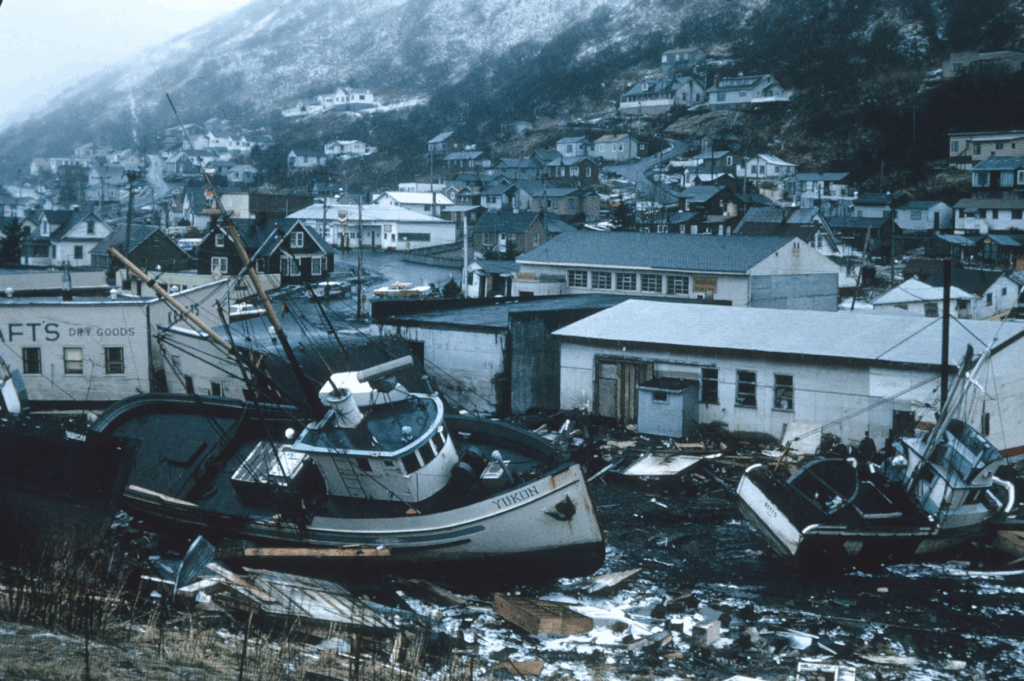
Dramatic photos revealed a frighteningly barren coastline with the ocean abruptly gone, a warning that a tsunami might strike at any time.
A tsunami has been confirmed, according to David Snider, a tsunami warning coordinator with the National Oceanic and Atmospheric Administration, who told KTUU that the tsunami caused tiny waves that caused water levels to rise by roughly three inches.
“A tsunami was generated by this event, but no longer poses a threat,” the Tsunami Warning Center said. “Some areas may continue to see small sea level changes.”
Shortly after the 7.3 magnitude earthquake occurred, the first alert was issued as a full tsunami warning. About 90 minutes later, it was downgraded to a tsunami advisory, and at 12:45 p.m. local time (6:45 p.m. ET), it was cancelled.
Residents are advised to exercise caution through Thursday as the unexpected waves are expected to last for around twenty-four hours.
Officials reported that Kodiak High School and North Star Elementary School had been made available to the public as emergency shelters as panic swept through coastal villages.
In a video that she sent to X, a resident of the port town of Seward in southern Alaska revealed that she had recently returned to Alaska after a 25-year absence, only to be forced to evacuate due to the possibility of a tsunami.
She and a few others may be seen in the video moving quickly away from the shore and onto higher land.
“Just pray we don’t get waved,” she says nervously, before ending the recording.
Following Wednesday’s massive earthquake, the Alaska Earthquake Centre has recorded over 20 aftershocks, the highest of which is magnitude 5.2.
Michael West, seismologist with the Alaska Earthquake Center, told Fox Weather: “The entire southern coast of Alaska is a gigantic earthquake zone. Four out of five earthquakes in the United States happen in Alaska.”
West pointed out that while earthquakes are frequent in the area, they rarely reach this magnitude and many are too minor to be felt.
“Early signs suggest we’re on the lucky side today,” he said.
Shortly after the massive earthquake, the National Weather Service (NWS) released a statement stating that Oregon, Washington, and other US states west of Alaska were not at risk of tsunamis.
According to the NTWC, the advisory’s coverage area was roughly 700 miles, from Unimak Pass, which is close to the eastern Aleutian Islands, to about 40 miles southwest of Homer.
Kodiak was one of the biggest communities in the advisory zone, home to about 5,200 people.
Local authorities in King Cove, a seaside community of roughly 870 people on the southern Alaska Peninsula, sent out an advisory asking residents in low-lying areas to evacuate to higher ground.
The previous time an earthquake of such size occurred in Alaska was on June 10, 1996, when a magnitude 7.2 earthquake occurred close to the Aleutian chain’s Andreanof Islands.
With a magnitude of 9.2, the Great Alaska Earthquake of 1964 was the strongest earthquake ever recorded in Alaska and the United States.
The enormous earthquake was felt as far away as Seattle and occurred close to Prince William Sound.
Devastating tsunamis were also produced by it, causing extensive devastation to the shores of Hawaii, California, Oregon, Alaska, and even Japan.
Please SHARE this article with Family and Friends and let us know what you think in comments!
