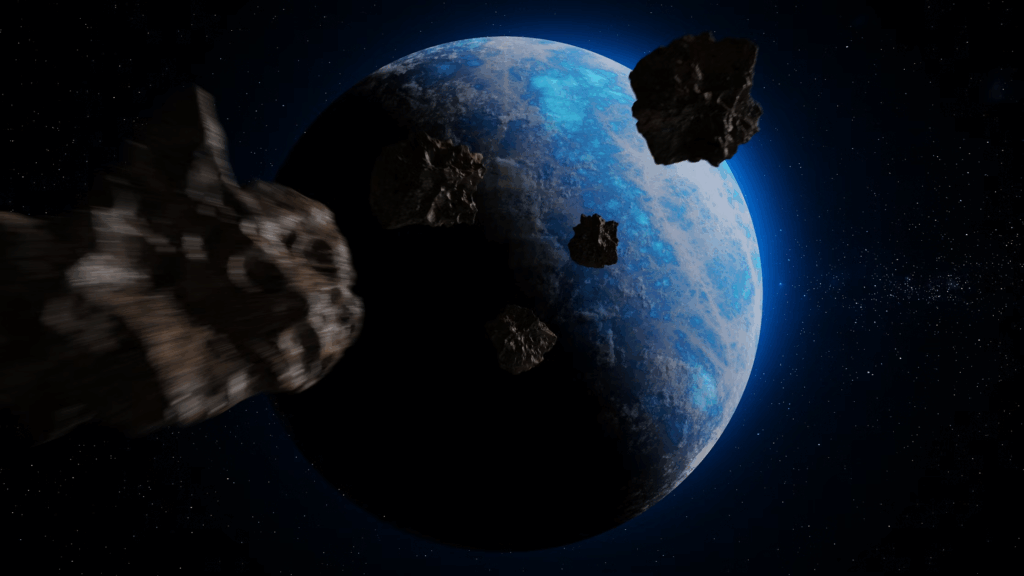
According to NASA, an asteroid the size of an airplane is expected to cross Earth next week. NASA specialists are eager to explain that the event will be “more routine than remarkable,” despite the fact that word of the massive rock’s approach has been making headlines.
The asteroid, officially designated 2025 OW, is said to be 220 feet in size. It will pass Earth on Monday, July 28 with 390,000 miles remaining, according to NASA’s plan. NASA’s online visualization of the massive space rock is available for viewing.
This is almost 1.6 times the typical distance to the moon, according to NASA. The moon and Earth are typically separated by roughly 239,000 miles (385,000 kilometers). Although it may seem extremely fast, the 2025 OW is traveling at 46,908 miles per hour, which is quite normal and shouldn’t cause any concern.
Speaking to ABC News, NASA’s Jet Propulsion Laboratory media relations specialist Ian O’Neill said: “This is very routine. If there was a threat, you would hear from us. We would always put out alerts on our planetary defence blog.”
According to Davide Farnocchia, a fellow NASA specialist in the space center’s Near-Earth Object Studies division, the incoming asteroid is ‘simply another day at the office’. He stated, “Close approaches happen all the time, it’s just part of the fabric of the solar system.”
Every week, his crew usually keeps an eye on several asteroids that come close to Earth. Despite the fact that 2025 OW is important enough to warrant NASA scientists’ attention, its well-known orbit suggests that it poses little threat.
“We have a precise understanding of its trajectory,” O’Neill said. “We will likely know its path for the next century.”
According to Farnocchia, space enthusiasts hoping to witness 2025 OW won’t be able to see it with binoculars. He does, however, draw attention to a more exciting event that is approaching: the 2029 approach of the asteroid Apophis.
A statement on NASA’s website reads, “Near-Earth asteroid Apophis is a potentially hazardous asteroid that will safely pass close to Earth on April 13, 2029. It will come about 20,000 miles (32,000 kilometers) from our planet’s surface — closer than the distance of many satellites in geosynchronous orbit (about 22,236 miles, or 36,000 kilometers, in altitude).”
It appeared that Apophis might strike Earth within the next few decades when it was initially discovered more than 20 years ago. On June 19, 2004, astronomers Roy Tucker, David Tholen, and Fabrizio Bernardi of Tucson, Arizona’s Kitt Peak National Observatory discovered apophis.
After careful astronomical monitoring, NASA is now confident that Apophis won’t pose a threat to Earth for at least the next century. Additionally, in April 2029, NASA rerouted a spacecraft to study Apophis during its closest approach to Earth.
What are near-earth objects?
Asteroids and comets that orbit within 120 million miles (195 million kilometers) of the Sun are considered near-earth objects because they can move through the orbital neighborhood of the Earth. Asteroids, which vary in size from roughly 10 feet (a few meters) to almost 25 miles (40 kilometers) across, make up the majority of near-Earth objects.
NASA says, “The orbit of each object is computed by finding the elliptical path through space that best fits all the available observations, which often span many orbits over many years or decades. As more observations are made, the accuracy of an object’s orbit improves dramatically, and it becomes possible to predict where an object will be years or even decades into the future – and whether it could come close to Earth.”
Where can I find more information?
Visit https://cneos.jpl.nasa.gov/ to learn more about the Center for Near-Earth Object Studies and to view impact-risk and close-approach information for all known near-Earth objects. Visit https://www.nasa.gov/planetarydefense/overview to find out more about NASA’s planetary defense policy and the Planetary Defense Coordination Office. Follow @AsteroidWatch on Twitter for news and updates about asteroids and comets.
Please SHARE this story with your Friends and Family and let us know what you think in comments!
