At first glance, it’s just four ordinary glasses filled with water. But here’s the catch—each one contains a different object, and your task is to figure out which glass holds the most water. Sounds easy, right? Think again. This visual brain teaser is sweeping across social media for a reason. It challenges how we see, think, and reason—and it’s trickier than it looks.
Let’s break it down and see if you can outsmart the internet.
What Makes This Puzzle So Deceptive?
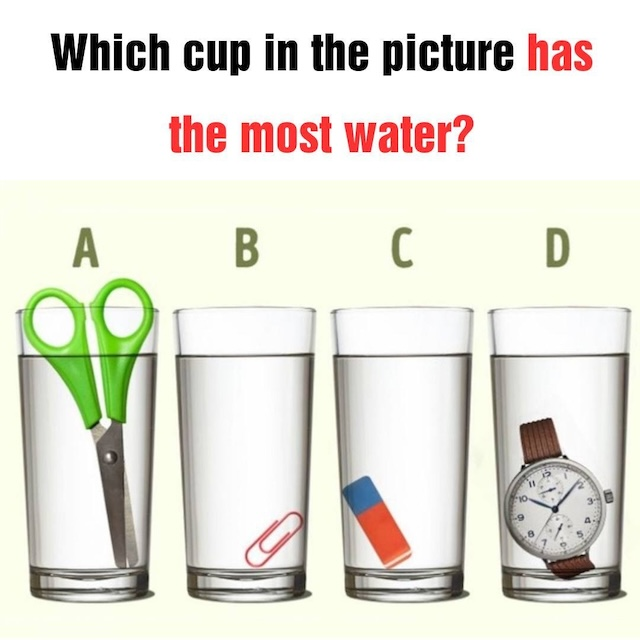
The trick isn’t in how much water you see—it’s in what’s inside each glass. All the glasses appear to have water filled to the same level, but the objects inside them change everything. This puzzle is all about water displacement, and if you’ve ever dropped an ice cube into a full glass, you’ve seen it in action.
Most people fall for the most obvious detail: the water level. But this puzzle’s real answer lies below the surface—literally.
Video: Which Glass has more water?
Understanding the Science: The Displacement Rule
Here’s a quick science refresher: when you drop an object into water, it pushes water out of the way. That’s called displacement. The heavier and bulkier the item, the more water it displaces, making the level rise—even if there’s actually less water in the glass.
So in this puzzle, the more an object pushes the water up, the less actual water is present in the glass. To find the correct answer, you’ll need to identify the object that displaces the least amount of water.
Let’s Break It Down: What’s Inside Each Glass?
Each of the four glasses contains one object:
- Glass A: A pair of scissors
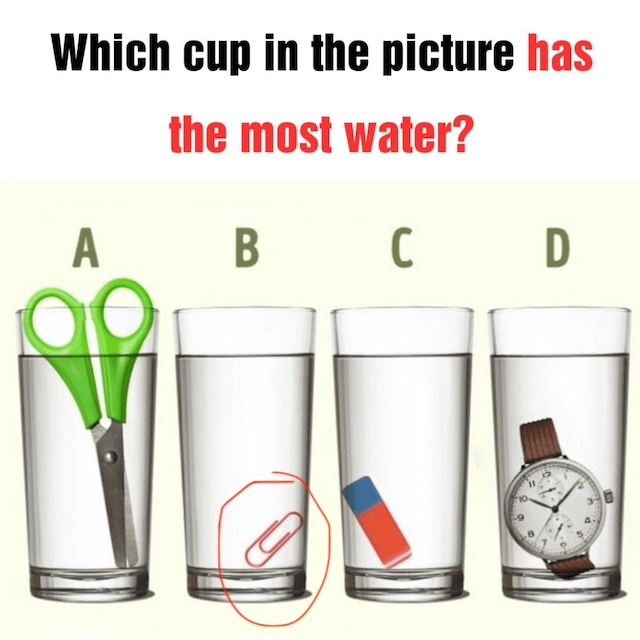
- Glass B: A small paper clip
- Glass C: A rubber eraser
- Glass D: A wristwatch
All the water levels look identical, but don’t be fooled. The key to solving this is determining which object is the lightest and smallest, because that object will displace the least water—meaning the glass holds the most actual water.
Step-by-Step: How to Solve the Puzzle Logically
Still unsure? Let’s walk through it step-by-step:
- Compare object sizes and weights.
A wristwatch and a pair of scissors are significantly larger than a paper clip. The rubber eraser sits somewhere in the middle. - Understand the impact.
The larger the object, the more space it takes up in the glass, meaning it pushes more water up and out of the way. - Reverse the visual trick.
If all four glasses show the same water level, but one has a tiny object and another has a heavy one, the one with the smallest object must contain more actual water. - Find the lightest object.
It’s the paper clip in Glass B. - Final Answer:
Glass B holds the most water, because the paper clip displaces the least amount of it.
Why Most People Get It Wrong
This puzzle reveals how easily our eyes deceive us. We’re wired to make fast judgments based on what’s obvious—like height, volume, or fullness. But we often overlook the invisible influences, like what’s inside or beneath.
In this case, the brain shortcut is “high water = more water,” but that’s not always true. The lesson here? Always ask what’s influencing what you’re seeing before you decide.
The Power of Observation and Logic
Puzzles like this aren’t just about having fun—they train your brain to think differently. When you slow down and observe instead of react, you give yourself a chance to think more clearly and spot the hidden details.
That’s a skill that doesn’t just apply to games—it’s useful in everyday life. Whether you’re solving problems at work, managing stress, or figuring out a new skill, sharpening your critical thinking can give you an edge.
What Makes This Puzzle Go Viral?
Video: 5 Logical Riddles That Will Break Your Head
Let’s face it: people love a good challenge. But the real magic is in how simple it looks. That’s what draws people in. You see four glasses, and you think, “How hard could this be?” But then you second-guess yourself. You debate. You argue with friends. You dig deeper.
It’s that moment of “Wait, am I missing something?” that makes this puzzle so addictive. It hooks you by playing with your expectations and rewards those who look beyond the obvious.
Challenge Your Friends: Can They Get It Right?
So now that you know the answer, here’s your next move: share this puzzle. See how long it takes your friends to figure it out. Better yet, don’t give them any hints. Let them go through the same “aha!” moment you did.
You might be surprised how many people get it wrong—at first. That’s part of the fun.
Conclusion: The Simplest Puzzles Are Sometimes the Smartest
The beauty of this puzzle isn’t just in its answer—it’s in the lesson. It teaches us that what we see isn’t always what’s real. It reminds us to think critically, question assumptions, and dig just a little deeper.
Next time you see a puzzle that looks “too easy,” pause for a second. Think it through. Because often, the smartest solutions come when we stop looking—and start thinking.
