Trump’s Remark Sparks Confusion
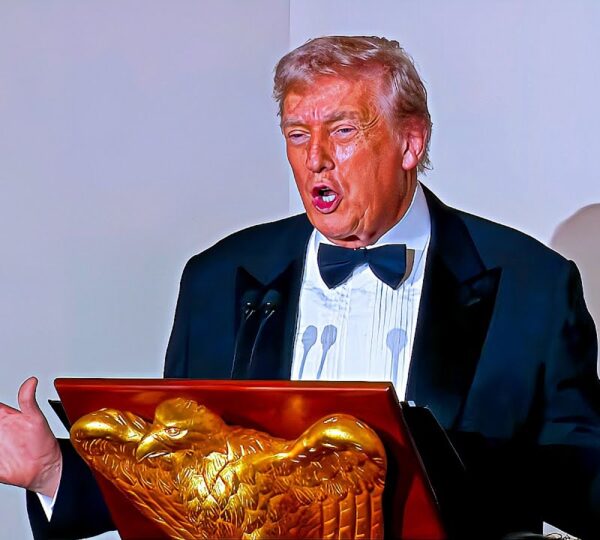
Former U.S. President Donald J. Trump ignited confusion and debate after remarks made at the White House Congressional Ball on December 11, 2025. During his speech, Trump suggested that European countries view him not only as America’s leader, but as a leader of Europe itself.
The comment spread rapidly online and triggered a wave of reactions worldwide.
Held each December, the Congressional Ball is a long-standing White House tradition. It brings together lawmakers, administration officials, and families for a formal evening of celebration and reflection. Presidents often use the event to highlight accomplishments and priorities.
This year, however, Trump’s remarks took an unexpected turn.
A Holiday Speech Takes a Sharp Shift
Trump opened with traditional holiday greetings, wishing attendees a “Merry Christmas” and a “Happy Hanukkah.” He then pivoted to what he described as his administration’s achievements.
He claimed the U.S. had attracted more than $18 trillion in investment, predicting it would surpass $20 trillion by year’s end. According to Trump, that figure exceeded any other nation’s total “by four times.”
He contrasted those numbers with what he said was less than $1 trillion under the previous administration. He framed the comparison as factual, not political.
Still, it was his comments on Europe that drew the most attention.
“Leader of Europe” Claim Draws Attention
Trump told the audience that European nations see the U.S. president as Europe’s leader.
“European countries are saying that your president might as well be the leader of Europe,” he said. He added that Europe now “listens to us and respects us like never before.”
He also returned to a familiar theme, arguing that the U.S. had long been treated unfairly by other nations.
“We get along with them,” Trump said. “But we’ve been ripped off by a lot of them for a very long time.”
The assertion immediately raised eyebrows, given Europe’s independent governments and political institutions.
Social Media Reacts Swiftly
As video clips circulated online, reactions poured in.
Some users expressed disbelief. Others responded with humor. Several questioned the accuracy of Trump’s claim.
One user joked, “Every European I know just asks, ‘What is America doing?’” Another added, “Same here. What is he talking about?”
Others pointed to public opinion polls that often show skepticism toward Trump’s leadership in Europe. A few dismissed the remarks outright, calling them exaggerated or delusional.
Part of a Broader Pattern
The comments did not come in isolation.
Days earlier, Trump criticized European leaders in an interview with Politico. He described several countries as “weak” and “decaying,” blaming political correctness and immigration policies.
He warned that some nations might no longer remain viable if current trends continued. He also questioned Europe’s handling of the war in Ukraine, suggesting Russia held the upper hand.
European officials and analysts have publicly disputed those claims.
European Officials Push Back
Across Europe, Trump’s remarks drew scrutiny and concern.
Critics argued the language undermines cooperation on security, trade, and diplomacy. Some viewed it as part of a broader shift in U.S. rhetoric toward its closest allies.
European leaders emphasized multilateral cooperation through institutions like NATO and the European Union. They rejected the notion that Europe seeks a single foreign leader.
Media outlets across the continent highlighted the unusual nature of Trump’s claim.
A Strained Transatlantic Relationship
The U.S. and Europe have shared close ties since World War II. NATO has anchored that alliance for decades.
Trump’s suggestion that Europe wants him as its leader contrasts sharply with that history. It has renewed debate about the future of transatlantic cooperation.
Public opinion surveys across Europe typically show mixed views of U.S. leadership. Attitudes toward Trump, in particular, often skew cautious or critical.
Political and Diplomatic Impact
Analysts say Trump’s rhetoric could affect negotiations on defense spending, trade, and global security.
The war in Ukraine has already tested Western unity. Trump’s criticism of European responses has intensified those discussions.
Domestically, European leaders may also face pressure to respond politically when their credibility is publicly questioned by a global figure.
Debate Likely to Continue
Trump’s comments have ensured one thing: the debate is far from over.
By suggesting Europe wants him as a leader, Trump challenged diplomatic norms and reignited discussion about power, sovereignty, and alliance politics.
In an era of shifting global dynamics, even a single remark can ripple far beyond the room where it was spoken.
And this one certainly has.
