
When House Speaker Mike Johnson first crossed paths with then-teenaged Michael Tirrell James in the mid-1990s, the moment carried the quiet urgency of a rescue mission. Johnson, then in his early twenties, was volunteering with a Christian ministry when he encountered Michael, a homeless Black teenager in Baton Rouge. According to Michael, and later media interviews, the Johnsons—Mike and his wife Kelly—opened their home to him when he was about 16 and he credits them with “saving” him from a bleak fate. Yet despite what looks like a familial bond, Johnson never completed a formal adoption of Michael—explaining that the adoption process would have been “lengthy.”
In countless interviews, Speaker Johnson has referred to Michael as his son—pointing to the contrast between Michael’s childhood and that of his white son Jack, stating that Michael “had a harder time simply because of the color of his skin.” But the paperwork was never filed. And that gap—between legal formality and familial devotion—has sparked questions not just about legal guardianship, but about love, race, and the burdens of redemption.
The back-story begins with a teenage boy whose life was unraveling. Michael Tirrell James says he drifted into homelessness after family troubles. When the Johnsons found him, they treated him like one of their own: baptisms, holidays, family dinners. Johnson has publicly said he believed “God intended for Michael to be a part of our lives.” They moved him into their home around 1999, and reportedly filed for legal guardianship—but never full adoption. Legal records remain opaque, but media reports show Michael lived with them and later left to build his own life.
Why did they stop short of full adoption? Johnson’s spokesperson acknowledged the decision to Newsweek in late 2023, saying the adoption was shelved because of the “lengthy … process” and that Michael was already an adult with his own family by the time Johnson ran for Congress in 2016. But beneath the procedural reason lies a more emotional current: Michael, having lived through instability and feeling the weight of race and expectation, reportedly chose a low profile. He did not participate in Johnson’s campaign and asked not to be publicly visible. His absence from public family photos and official bios raised eyebrows.
Friends and former ministry associates say the Johnsons intervened when Michael was teetering on the brink. Michael told Daily Mail that “If the Johnsons hadn’t taken me in as a teenager, my life would look very different—I would probably be in prison or I might not have made it at all.” For the Johnsons, this seems to have fulfilled a Christian mandate: rescue-the-child, give him a chance. Yet Michael’s journey afterward was not seamlessly smooth. Records cited by Western Journal and others show run-ins with law enforcement from 2003 onwards—drug charges, theft, and other legal troubles.
Michael’s path complicates the neat story of “rescued kid flourishes.” He fathered four children of his own, lives out west, and apparently chose daily work over limelight. Meanwhile, Speaker Johnson ascended politically—into one of the most powerful positions in the country—and his story was ever more in the glare of media scrutiny. The absence of Michael from that spotlight stands out. Johnson’s office insisted the omission wasn’t neglect but respect: Michael asked not to be part of their political life.
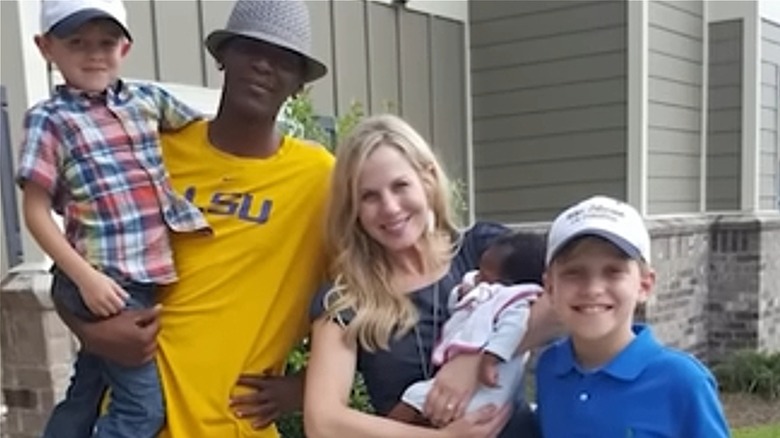
Emotionally, the decision not to adopt hints at a quiet complexity. Full adoption would legally cement Michael’s place as their child—but it also would make his struggles and Michael’s life more visible, more entangled with Johnson’s political identity. By remaining a guardian rather than adoptive parent, perhaps Johnson and Kelly preserved space for Michael to define himself outside the family brand. Michael, too, may have felt pressure: the possibility of “living up” to the image of the Speaker’s rescued son—or of being forever the “Black son” in a white conservative family.
Johnson has publicly referenced Michael when discussing race: “Michael being a Black American … they have different challenges,” he told PBS. But the public has rarely heard Michael’s voice. When he finally spoke, it was to acknowledge gratitude and to accept imperfection: “They have been there for me when I have been lost … I know it was hard at times to constantly help someone who didn’t always get it right,” he said.
What stays untold is how that dynamic played out inside the household when Johnson became a national figure. Did Michael feel that raising him helped open doors—or shut them? Did the Johnsons allow him enough independence to stumble, learn, and forge his own way? Did Michael’s absence from campaign framing stem from his own choice—or a strategic omission? The public record won’t answer those questions.
In the end, the legal papers never captured the love, the guardian bond, the risk the Johnsons took when they opened their home. But neither did they protect against shame, identity confusion, or public suspicion. The story of Speaker Mike Johnson and Michael Tirrell James serves as a quiet testament to Christian charity, complicated by race and politics, made messier by human imperfection. The phrase “I never adopted him because it was lengthy” may ring procedural, but beneath it lies a thousand unsaid sentences: fear of public spectacle, choice of privacy, respect for autonomy, and the enduring ache that comes with salvation that is imperfect.
