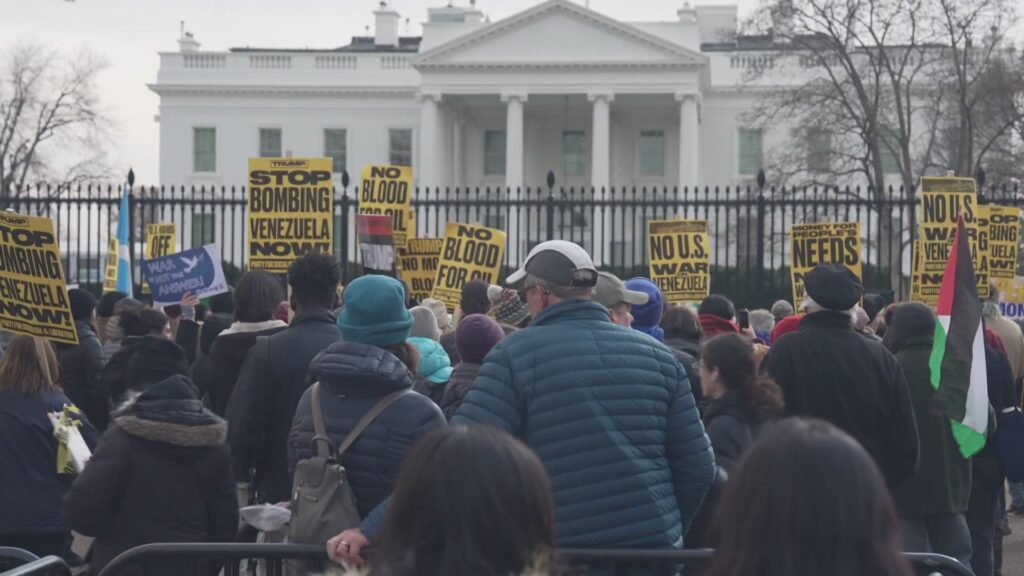
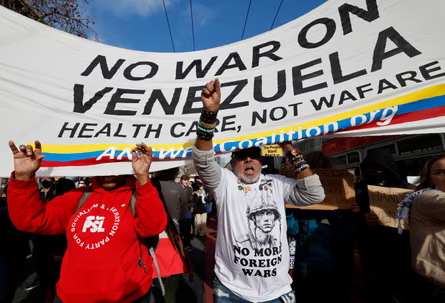
As evening settled over Washington, D.C., hundreds of demonstrators gathered outside the White House in a rapidly organized protest triggered by President.
Donald Trump’s dramatic public announcement regarding Venezuela. According to the president’s statements, the United States had carried out airstrikes and taken Venezuelan President Nicolás Maduro.
Into custody actions he framed as both a national security measure and a law enforcement operation.
While these claims immediately dominated headlines and social media, they were also met with skepticism, legal questions, and calls for verification, setting the stage for a tense and emotionally charged response in the nation’s capital.
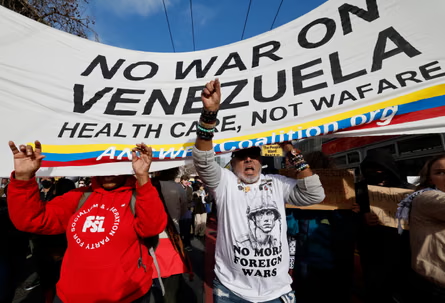
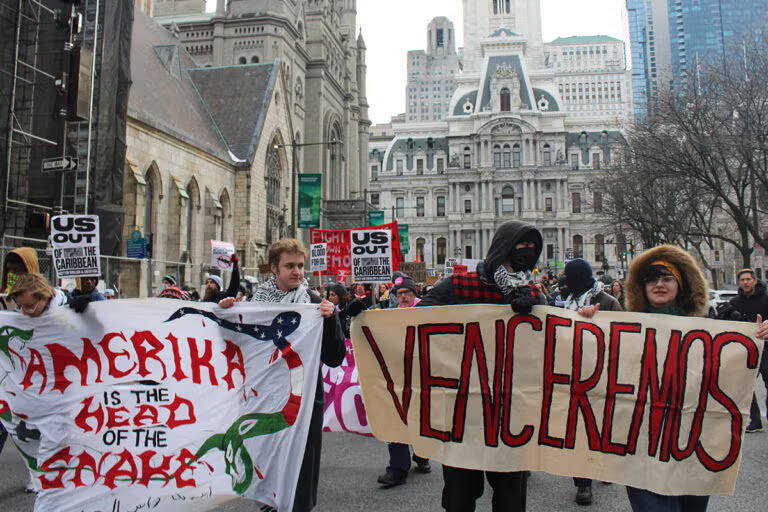
The protest formed within hours, coordinated through social media platforms, messaging apps, and long-established activist networks. Participants included anti-war advocates, civil liberties organizations, students, faith-based groups, and concerned citizens with diverse political views.
Despite their differences, protesters shared a common concern: the potential expansion of executive power, the use of military force without clear congressional authorization, and the precedent implied by announcing the removal of a foreign leader and the assertion of temporary control over another sovereign nation.
Many demonstrators carried handmade signs calling for peace, restraint, and respect for international law.
Slogans emphasized that opposition to the announced military action did not amount to support for Nicolás Maduro or his government.
Instead, protesters repeatedly stressed that it was possible to condemn authoritarianism abroad while still opposing unilateral military intervention and what they viewed as a dangerous erosion of legal and constitutional norms.
This distinction became a central theme of the demonstration, reflecting a broader public debate already unfolding across the United States.
Earlier in the day, President Trump had publicly described Maduro as a “narco-terrorist” allegedly overseeing a criminal enterprise that posed a direct threat to U.S. security.
He claimed that Maduro and his wife were in federal custody in New York and would face serious criminal charges. Framing the announcement as decisive action after years of alleged criminal conduct, Trump portrayed the move as both overdue accountability and a demonstration of American resolve.
Supporters of the president praised the announcement as a bold stance against authoritarianism and transnational crime, arguing that it signaled a willingness to enforce international norms when other mechanisms had failed.
However, critics quickly raised questions about the legal basis and broader implications of such actions.
Constitutional scholars, former diplomats, and members of Congress cautioned that even if allegations against a foreign leader were severe, the use of military force and claims of detention required clear legal justification and transparent processes.
For many protesters outside the White House, the concern was not only about Venezuela but also about the long-term consequences for U.S. democracy and the balance of power between the executive branch and Congress.
One of the most frequently cited issues during the protest was the War Powers Resolution. Senator Tim Kaine and other lawmakers publicly argued that sustained military engagement would require congressional authorization, regardless of how the operation was described.
Legal experts echoed this view, noting that past administrations of both parties had faced criticism for expanding executive authority in matters of war and peace.
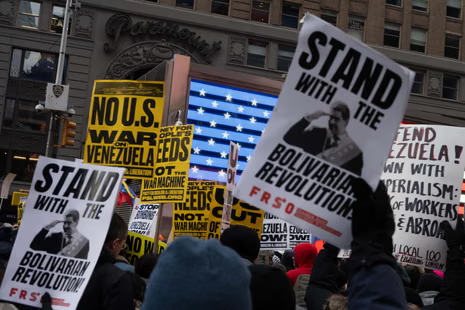
Protesters expressed fear that accepting such actions without debate or oversight could normalize a pattern of unilateral intervention.
International law was another central focus of the demonstration. Speakers and signs referenced principles of sovereignty and non-intervention, warning that openly declaring control over another country, even temporarily, risked undermining long-standing global norms.
Protesters drew parallels to previous U.S. interventions that were initially framed as limited or humanitarian but evolved into prolonged conflicts with devastating human and regional consequences.
While acknowledging the serious humanitarian and political crisis in Venezuela, demonstrators questioned whether military force announced without international consensus could realistically lead to stability or reform.
The reaction abroad added to the sense of unease. Although some governments and political figures expressed tentative support for holding authoritarian leaders accountable, others reportedly condemned the announcement as a violation of sovereignty and international law.
Protesters in Washington pointed to these reactions as evidence that the United States risked diplomatic isolation, strained alliances, and increased instability in Latin America.
Concerns were also raised about migration pressures, economic disruption, and the possibility of retaliation or escalation, all of which were discussed as potential outcomes rather than established facts.
Within the United States, public opinion appeared sharply divided. In cities such as Miami, home to a large Venezuelan American community, some residents voiced support for the president’s claims, viewing the announcement as long-awaited accountability after years of repression and economic collapse in Venezuela.
These perspectives were widely shared in media coverage and online discussions, highlighting the emotional weight of the issue for communities with direct personal ties to the country.
At the same time, other Venezuelan Americans urged caution, emphasizing the need for verified information, lawful procedures, and protection of civilians. Outside the White House, the atmosphere remained intense but largely peaceful.
Chants calling for congressional oversight, international cooperation, and diplomatic solutions echoed through the crowd. Organizers emphasized nonviolence and urged participants to remain focused on constitutional principles rather than partisan loyalty.
As night fell, the protest became a visible symbol of the broader national debate: how the United States should respond to authoritarian regimes, what limits exist on presidential power, and how to reconcile security concerns with the rule of law.
As demonstrators began to disperse, there was no sense of closure. Instead, the protest underscored how unresolved the situation remained.
Key questions persisted about the accuracy of the president’s claims, the legality of the announced actions, and the potential consequences for both Venezuela and U.S. foreign policy.
While supporters and critics interpreted the announcement in starkly different ways, the gathering outside the White House reflected a shared recognition that the stakes were high and that decisions made in moments of crisis could shape international norms and domestic governance for years to come.
As the immediate protests outside the White House faded from view, the broader debate triggered by President Trump’s announcement continued to intensify across legal, political, and international arenas.
At the center of this debate was not only the situation in Venezuela, but also fundamental questions about how the United States exercises power on the global stage and how far presidential authority can extend without explicit legislative approval.
Legal scholars were among the first to raise detailed concerns. Many emphasized that public statements by a president, even when framed as law enforcement actions, do not substitute for established legal processes.
Experts in constitutional law noted that the distinction between a limited operation and sustained military involvement can quickly blur, particularly when airstrikes or claims of territorial control are mentioned.
According to these analysts, the War Powers Resolution exists precisely to prevent prolonged military engagement without congressional debate, regardless of how such actions are labeled politically.
Senator Tim Kaine’s comments gained particular attention, as he reiterated that Congress has a constitutional role in authorizing military force.
His position was echoed by other lawmakers from both parties, some of whom expressed concern that bypassing Congress weakens democratic accountability.
These arguments were not presented as opposition to holding foreign leaders accountable, but rather as a defense of institutional checks and balances that have historically governed U.S. military actions.
Beyond domestic law, international legal norms became a major point of discussion. Specialists in international relations stressed that sovereignty remains a foundational principle of the global system.
Even when a leader is accused of serious crimes, unilateral action by another state raises difficult questions about precedent.
Critics warned that normalizing such behavior could encourage other powerful nations to justify interventions under similar claims, potentially increasing global instability.
These concerns were framed as analytical assessments rather than predictions, acknowledging that outcomes depend on how international institutions and governments respond.
Diplomatic reactions around the world continued to evolve. Some governments issued carefully worded statements calling for restraint, dialogue, and verification of facts.
Others expressed concern about escalation and urged respect for international law. Analysts observed that even allies of the United States appeared cautious, reflecting an awareness that public declarations of force can complicate diplomacy, trade relations, and regional cooperation.
In Latin America, where memories of foreign intervention remain deeply embedded in political discourse, reactions were especially sensitive.
Humanitarian considerations also emerged as a significant theme. Advocacy groups warned that heightened tensions could worsen the already severe humanitarian crisis facing Venezuelan civilians.
While no immediate changes on the ground were confirmed, organizations emphasized that instability, sanctions, or military pressure often have indirect effects on access to food, medicine, and basic services.
These warnings were presented as risk assessments based on past experiences rather than assertions of inevitable outcomes.
Media coverage played a crucial role in shaping public perception. Traditional news outlets attempted to balance reporting on presidential statements with expert commentary and calls for confirmation.
At the same time, social media platforms amplified both support and opposition, sometimes blurring the line between verified information and speculation.
Analysts noted that such environments can intensify polarization, making it harder for citizens to distinguish between official claims, journalistic investigation, and opinion-driven narratives.
Within the United States, the public conversation expanded beyond Venezuela to encompass broader foreign policy questions.
Many commentators asked whether the country had learned from previous interventions that were initially described as limited but later evolved into long-term engagements.
Protesters and critics pointed to historical examples where promises of swift resolution gave way to extended conflicts, arguing that caution and transparency were essential to avoid repeating past mistakes.
Supporters of the president, however, continued to argue that decisive action sends a strong message to authoritarian leaders and criminal networks.
From this perspective, delays caused by prolonged debate can undermine deterrence and embolden actors who exploit perceived hesitation.
This view resonated with segments of the population frustrated by what they see as ineffective international mechanisms and prolonged diplomatic stalemates. The coexistence of these opposing perspectives highlighted the deep divisions in how Americans interpret power, responsibility, and global leadership.
The role of Congress remained uncertain. While some lawmakers called for hearings, briefings, and potential resolutions, others urged restraint until more verified information became available.
This cautious approach reflected awareness that premature action could inflame tensions without clarifying facts. As a result, institutional responses unfolded slowly, reinforcing the sense that the situation was still developing rather than settled.
Internationally, analysts suggested that the long-term impact of the announcement would depend less on the rhetoric itself and more on subsequent actions.
Would there be sustained military involvement, diplomatic negotiations, or legal proceedings supported by international cooperation?
Each of these paths carries different implications for global norms and U.S. credibility. These scenarios were discussed explicitly as theoretical possibilities, not as confirmed plans.
For protesters who had gathered outside the White House, these unresolved questions were precisely the point. Many described their presence as an attempt to signal public concern before irreversible steps were taken.
They argued that democratic societies function best when debate precedes action, especially in matters of war and peace. Organizers emphasized that protest was not an endpoint, but part of an ongoing civic process intended to influence policymakers.
As days passed, the initial shock of the announcement gave way to a more measured, though still intense, national conversation.
Editorials, panel discussions, and academic forums examined the legal, moral, and strategic dimensions of the situation.
While opinions varied widely, there was broad agreement that the episode had exposed persistent tensions in U.S. foreign policy: between speed and deliberation, authority and accountability, national interest and international norms.
Ultimately, the episode underscored how modern conflicts are shaped not only by actions on the ground, but also by information, perception, and institutional response.
Whether the announcement would mark a turning point or fade into a contested chapter of political history remained unclear.
What was evident, however, was that the debate it ignited—over executive power, international law, and the limits of intervention—was far from resolved.
In that sense, the protests outside the White House were less about a single country or leader and more about enduring principles.
They reflected a public grappling with how a powerful nation should act in a complex and interconnected world, and how democratic oversight can be preserved even in moments of crisis.
As with many such debates, the final outcomes will likely be shaped over time, through legal processes, political negotiation, and continued public engagement rather than through any single announcement or demonstration.
