The Santa Ana winds were blowing that night, the kind of dry, static-charged gusts that whip through the Los Angeles basin in December, making everyone a little on edge. They say the ions in the wind make people crazy, make them do things they wouldn’t normally do. I drove my 2014 Honda Civic up the winding roads of Beverly Hills, the engine whining in protest against the incline. Below me, the city grid of Los Angeles glittered like a spilled jewelry box, indifferent and vast.
I wasn’t looking at the view, though. My knuckles were white on the steering wheel, my heart hammering a nervous rhythm against my ribs. I was looking at the address written on a scrap of envelope taped to my dashboard, right next to the little plastic Jesus my sister had glued there ten years ago.
My son, Marcus, had been a ghost for twelve months. One year of unreturned calls. One year of birthday cards sent into the void. One year of wondering if I had imagined the closeness we once shared, or if mothers just delude themselves into thinking they matter once their children grow tall and rich.
The silence had been a physical weight, a stone I carried in my chest every time I went to the grocery store or watched Wheel of Fortune alone in my apartment. I had replayed our last conversation a thousand times, searching for the sin I must have committed. Had I been too needy? Had I embarrassed him? Had I asked for money? No, I never asked for money. I knew how expensive his life was, even if I didn’t understand it.
Then came the call, three days ago.
“Mother,” he had said. His voice was stripped of inflection, smooth and cool like a polished stone. “Come for Christmas dinner. Saturday. Six o’clock sharp.”
He hung up before I could ask if he was okay, or why he had vanished, or if he missed me. I didn’t care. The invitation was a lifeline, and I grabbed it with both hands. I spent two days preparing. I bought a new dress—navy blue, because Marcus always said I looked dignified in blue. I got my hair set. I baked his favorite cookies, the ones with the macadamia nuts, even though my arthritis was flaring up in the cold weather.

I pulled up to the gate of number 2847. It was a monolith of modern architecture—glass, steel, and white stone, bathed in soft amber uplighting. A fountain in the center of the circular driveway shot water into the air, the spray catching the wind and misting the windshield of my humble car. It looked less like a home and more like a museum where you weren’t allowed to touch anything.
I parked my dusty car next to a sleek black Range Rover that looked like it cost more than my entire life’s earnings. I checked my reflection in the rearview mirror—lipstick applied with a shaking hand, gray hair teased to hide the thinning spots—and grabbed the gift from the passenger seat.
It was a vintage watch, a 1960s Omega Seamaster. I had dipped deep into my meager retirement savings to buy it. It cost three thousand dollars—money I needed for a root canal I was putting off—but I wanted him to know I still saw him as worthy of the best. I wanted to walk into that palace of a house and not feel like the poor relation. I wanted to be his mother, the provider, one last time.
I walked up the stone path, my sensible heels clicking on the slate. Through the floor-to-ceiling windows, I saw a twelve-foot Christmas tree, shimmering with silver and gold ornaments. It was breathtaking. Underneath it lay piles of gifts wrapped in silk paper.
I raised my hand to ring the doorbell, taking a deep breath to steady my nerves. Just smile, I told myself. Don’t cry. Don’t ask where he’s been. Just be grateful he’s back.
Before I could touch the button, the heavy front door cracked open.
It wasn’t Marcus. It wasn’t his wife, Diana, the woman who always looked at me like I was a stain on her beige carpet.
It was a woman in a black uniform with a white apron. Maria. I remembered her from two years ago—quiet, efficient, with kind eyes that always seemed a little sad. She had made me tea once when Marcus left me waiting in the foyer for an hour.
Tonight, those eyes were wide with terror.
She slipped out onto the porch, closing the door softly behind her until it clicked. The wind whipped her uniform, but she didn’t seem to notice the cold. She grabbed my arm, her fingers digging into the wool of my coat with shocking strength.
“Mrs. Henderson,” she hissed. The wind whipped a strand of dark hair across her face, but she didn’t brush it away. “You cannot go in there.”
I blinked, smiling uncertainly, my brain refusing to process the urgency in her voice. “Maria? It’s me, Dorothy. Marcus invited me. Is he… is he angry that I’m early? I can wait in the car.”
“He isn’t angry,” she whispered, her voice trembling so hard it scared me more than the wind. “He is waiting. But you must not go in. Please. You have to get back in your car and drive away. Right now.”
“I don’t understand,” I said, clutching the gift box to my chest like a shield. “It’s Christmas. I haven’t seen him in a year. Why are you blocking the door?”
She looked over her shoulder at the glass house. Inside, I saw a silhouette move across the living room—broad shoulders, confident stride. Marcus. My heart leaped with a mix of love and desperate longing.
“I could lose everything for telling you this,” Maria said, tears pooling in her eyes. “My job. My visa. Everything. But I have a mother in Guatemala. If someone did to her what they are planning to do to you… I would want to know.”
She leaned in close, her breath smelling of peppermint and absolute fear.
“There is poison in the food, Mrs. Henderson. The soup. It is meant for you. Please. Run.”
The world stopped spinning. The sound of the fountain faded into a dull roar.
“Poison?” I repeated, the word feeling heavy and foreign in my mouth. “That’s… that’s ridiculous. Marcus loves me. He’s my son. We’re having Christmas dinner.”
“He loves money,” she corrected, a tear finally spilling over and tracking through the powder on her cheek. “He and his wife… they have been talking about it for weeks. The insurance. The heart attack. It is all planned. Please. I am begging you. Go.”
She shoved me, not out of malice, but out of desperation. “Go! Before he sees you!”
The look on her face—the raw, unfiltered panic—shattered my denial. This wasn’t a misunderstanding. This wasn’t a rude dismissal. This was a warning from a woman who had nothing to gain and everything to lose.
I stumbled back. The cold wind bit through my coat, chilling the sweat that had broken out on my back. I turned and walked, then jogged, then ran back to my car. I fumbled with the keys, dropping them on the asphalt, scratching my knuckles as I snatched them up.
I threw myself into the driver’s seat and locked the doors. As I reversed down the driveway, my tires screeching slightly, I looked back at the house one last time.
The front door opened.
Marcus stepped out onto the porch. He looked handsome in his cashmere sweater, the picture of the successful American son. He held a wine glass in one hand. He looked at my retreating car, and he didn’t wave. He didn’t look confused. He didn’t pull out his phone to call me.
He just watched me go, his face as blank as a tombstone.
The Longest Drive Home
I didn’t go home. I couldn’t. My apartment in Riverside felt too far, and yet, nowhere felt safe. The freeway was a ribbon of red taillights, thousands of people going to families that loved them, while I was fleeing the child I had birthed.
I drove until my hands stopped spasming, pulling into the empty parking lot of a 24-hour pharmacy three miles down the hill on Sunset Boulevard. The neon sign buzzed overhead. I killed the engine and sat in the dark, the heater ticking as it cooled.
My mind was a chaotic slideshow, flashing images faster than I could process them.
Marcus as a baby, gripping my pinky finger with a strength that surprised me. Marcus at ten, crying because he scraped his knee, letting me clean it with peroxide while I sang to him. Marcus at sixteen, screaming that he hated me because I wouldn’t let him go to a party, only to apologize an hour later with a hug. Marcus at graduation, looking over my shoulder at his rich friends instead of at the camera, ashamed of my old car.
Poison.
It wasn’t possible. It was the plot of a bad movie. It was something that happened to other people, to families on the news, not to us. We were the Hendersons. We struggled, we fought, but we survived.
But then I remembered the silence. The twelve months of nothing. The way he had looked at me the last time we met, like I was a piece of furniture he wanted to replace. And the sudden invitation. Six o’clock sharp. Not “Come early to talk.” Just “Come to eat.”
My phone buzzed on the passenger seat, making me scream.
I stared at the screen. Unknown Caller.
If it was Marcus, what would I say? “Did you try to kill me?” “Why?”
I answered, my hand shaking so much I almost dropped the device between the seats.
“Hello?” My voice was a croak, unrecognizable even to myself.
“Dorothy Henderson?” A man’s voice. Deep. Authoritative. Not Marcus.
“Yes?”
“This is Detective James Rodriguez, Beverly Hills PD. Where are you right now?”
“I’m… I’m in a parking lot. On Sunset. Near the CVS. Why? What’s happened?”
“Stay there,” he commanded. “Do not move. Do not go back to the residence on Canyon Ridge. Do you understand me?”
“I left,” I whispered, tears finally starting to fall hot and fast down my frozen cheeks. “The maid… Maria… she told me to run.”
There was a pause on the other end of the line. A heavy sigh of relief.
“She got to you,” the detective said. “Thank God. Mrs. Henderson, listen to me very carefully. You are safe now, but your son is being taken into custody as we speak.”
“Custody?” I choked out. “For what?”
“Conspiracy to commit murder,” he said. The words were sterile, legal, devoid of the horror they contained. “We have the audio. We have the search history. We have the toxins.”
I slumped against the steering wheel, the phone pressed to my ear, listening to the siren of a police cruiser wailing in the distance, getting closer and closer to the house I had just fled. The house where my Christmas dinner was waiting. The house that was supposed to be a reunion, but was actually a slaughterhouse.

The Evidence Room
The police station was too bright. The fluorescent lights hummed with a headache-inducing frequency. They gave me a cup of lukewarm coffee in a Styrofoam cup and sat me in a small room with gray carpet walls that smelled of stale cleaner and misery.
Detective Rodriguez came in twenty minutes later. He looked tired, his tie loosened, a stain of coffee on his shirt. He sat across from me and placed a thick file folder on the table.
“I know this is a shock,” he said gently. “But I need to show you why we moved tonight. I need you to understand that this wasn’t a misunderstanding.”
He opened the file.
“Did you know about the insurance policy?” he asked.
“What policy?” I asked, wiping my eyes with a rough paper towel. “I have a small life insurance plan. Maybe ten thousand dollars. Enough to bury me and maybe throw a small wake.”
“Not yours,” he said. “Your late husband’s. Robert.”
“Robert died thirty years ago,” I said, bewildered. “That money is long gone. It paid off the car and kept food on the table for six months while I got my teaching credential.”
“There was a secondary rider on his executive plan,” Rodriguez explained, tapping a document with his pen. “It was tied up in a class-action lawsuit against the insurer for decades. Gross negligence on their part. It finally settled last November. The payout was significant. Two point eight million dollars. And since Robert had no other will, and never remarried, you are the sole beneficiary.”
“Two point eight million?” I gasped. The number didn’t make sense. It was Monopoly money. It was a lottery win I hadn’t bought a ticket for.
“The notification letters were sent to your old address,” Rodriguez continued. “But your mail forwarding expired. Your son, however, found out. He works in finance. He saw the settlement come through on a legal database he has access to.”
He slid a transcript across the table.
“This is a recording from inside your son’s home, taken yesterday. Maria Santos agreed to wear a wire after she overheard them planning it.”
I recoiled from the paper as if it were burning. “I don’t want to read it.”
“You have to,” Rodriguez said softly. “You have to know.”
I looked at the paper. The words were typed out, sterile and black, but I could hear Marcus’s voice in my head as I read them.
Marcus: “It has to be the soup. The bitterness of the kale will mask the digitalis.” Diana (his wife): “Are you sure the dose is right? We can’t have her just getting sick. She has to die, Marcus. If she survives and the money hits her account, she might donate it to one of her stupid charities or spend it on that church.” Marcus: “She won’t survive. She has a weak heart. It’ll look like cardiac arrest brought on by the stress of travel. I’ll cry, we’ll call 911, and by Monday, the transfer forms will be signed.”
I pushed the paper away. I felt sick. Violent, physical nausea.
“He’s… he’s broke,” Rodriguez said softly. “Your son. He’s leveraged to the hilt. Crypto bad bets, gambling debts in Vegas, a mortgage he can’t afford. He needed that three million to stay out of federal prison for fraud. You were just… an obstacle.”
An obstacle.
I wasn’t his mother. I wasn’t the woman who taught him to tie his shoes. I wasn’t the woman who sat up with him when he had the chickenpox. I wasn’t the woman who sacrificed her own happiness so he could have a shot at the big time.
I was a barrier between him and a pile of cash.
“Maria?” I asked, my voice trembling. “Is she okay?”
“She’s in protective custody,” Rodriguez said. “She’s a brave woman, Mrs. Henderson. She knew he was dangerous. She stepped in front of a train for you. She’s currently at a safe house.”
I nodded slowly. The reality was settling in like concrete hardening around my feet. I had no son. I had a predator who shared my last name.
The Year of Silence: A Mother’s Perspective
To understand the pain of that moment, you have to understand the year that preceded it.
When Marcus stopped talking to me, it wasn’t a dramatic fight. There was no shouting match. It was a slow fade, like a radio station losing its signal.
First, the calls got shorter. “I’m busy, Mom.” “Can’t talk, in a meeting.” “Why do you call so much?”
Then, they stopped being answered.
I spent Thanksgiving alone that year. I cooked a small turkey breast and ate it while watching a Hallmark movie, telling myself he was just traveling.
Christmas came and went. I sent a package—a cashmere scarf and homemade cookies. It came back three weeks later marked Return to Sender. He hadn’t even opened it.
I lay awake at night in my apartment, staring at the ceiling fan, dissecting my parenting.
Was I too strict? Did I love him too much? Did I make him feel guilty for my sacrifices?
I remembered when he got into Stanford. I sat at the kitchen table with the acceptance letter, weeping with joy. He looked at me, his eighteen-year-old face filled with a mix of pride and anxiety.
“But we can’t afford it, Mom,” he had said.
“We will make it work,” I promised. “I will take a second mortgage. I will work nights. You are going.”
And I did. I scrubbed floors. I tutored bratty kids on weekends. I wore the same winter coat for twelve years.
And now, I realized, he didn’t see that as love. He saw it as a debt. A burden. He hated me for my sacrifice because it made him feel beholden. And Marcus, in his fancy suit and glass house, hated feeling small.

The Long Wait for Justice
The months that followed the arrest were a blur of legal motions and media frenzies. The story was catnip for the press: “The Beverly Hills Christmas Plot.” “The Millionaire Murderer.” “The Soup That Could Kill.”
I couldn’t go back to my apartment. The press was camped out on the lawn. The District Attorney, a sharp woman named Sarah Klene, arranged for me to stay in a secure townhouse near the courthouse.
I spent my days meeting with Sarah, going over the evidence.
“They’re going to come for you, Dorothy,” Sarah warned me one afternoon. She was young, fierce, with eyes that missed nothing. “The defense strategy is going to be character assassination. They’re going to paint you as a smothering, obsessive mother who drove her son to the brink. They’re going to say this whole conspiracy is a misunderstanding, a joke taken out of context.”
“A joke?” I asked, incredulous. “Digitalis isn’t a punchline.”
“They’ll say he was researching a screenplay,” Sarah said, rolling her eyes. “Rich boys always think they’re writers when they get caught.”
I met Maria again during this time. We met in a secure conference room. She looked smaller out of her uniform, wearing jeans and a sweater.
I hugged her, and we both wept.
“Why did you do it?” I asked her. “You didn’t even know me.”
“I knew you,” she said in her soft, accented English. “I saw the way you looked at him in the photos on his desk. And I saw the way he looked at you when you called—rolling his eyes, putting the phone down on the table while you talked. It broke my heart. And then… when I heard the poison… I thought of my own mother. If I was in danger, I would pray for a Maria.”
We held hands, two women from different worlds, bound by the cruelty of a man who thought he was better than both of us.
The Trial: Day One
The trial began in spring. The Los Angeles sun was shining, indifferent to the darkness inside the courthouse.
The courtroom was packed. When the bailiff announced the case, a hush fell over the room.
They walked Marcus in. He was wearing a suit I recognized—I had bought it for him when he landed his first big job at the firm. He looked thinner, his face drawn. His arrogance was still there, but it was brittle now, like a cracked shell.
He refused to look at me. He stared straight ahead at the judge, his jaw clenched.
His wife, Diana, sat beside him. She looked small and frightened, playing the part of the dutiful wife caught in a bad situation. But I knew better. I had read the texts. I knew she was the one who suggested the kale to hide the bitter taste.
The prosecution was ruthless. Sarah Klene was a surgeon with a scalpel.
She played the tapes.
The sound of my son’s voice filled the high-ceilinged courtroom, amplified by the speakers.
“I’ve been playing the grieving son my whole life. One more performance won’t kill me.”
The jury flinched. I saw a woman in the front row cover her mouth. A man in the back shook his head.
Then, they called Maria to the stand.
She walked in with her head held high, though I could see her hands shaking. She told the story of the overheard conversations. She told the story of the poison purchase she had found the receipt for in the trash, which she had photographed with her phone.
Then, the defense attorney, a slick man with a shark’s smile named Mr. Sterling, stood up. He walked toward Maria like a predator circling prey.
“Ms. Santos,” he sneered. “You are an undocumented immigrant, are you not?”
“Objection!” Sarah shouted. “Relevance!”
“It goes to credibility, Your Honor,” Sterling argued. “This witness has a powerful motive to lie.”
The judge allowed it.
“Isn’t it true,” Sterling continued, leaning into her face, “that you concocted this dramatic story to secure a U-Visa? That you knew if you became a victim or a witness to a major crime, you could stay in the United States? You destroyed a man’s life for a green card, didn’t you?”
Maria leaned into the microphone. Her voice was steady, cutting through the lawyer’s bluster.
“I did not do this for a visa,” she said clearly. “I did this because I have a mother. And if my son tried to kill me for money, I would hope someone would have the courage to tell me. Even if it meant I had to leave this country forever.”
The courtroom erupted in murmurs. Sterling paused, his rhythm broken. He had no response to moral courage.
The Trial: The Defendant Speaks
Against the advice of his legal team, Marcus insisted on testifying. It was his narcissism. He believed he could charm the jury. He believed he was smarter than everyone in the room.
He sat on the stand, crossing his legs, looking relaxed.
“Mr. Henderson,” his lawyer asked. “Did you intend to kill your mother?”
“Absolutely not,” Marcus said, looking at the jury with wide, innocent eyes. “I love my mother. She’s… difficult. She’s overbearing. But I love her. The conversations Maria heard were taken out of context. Diana and I have a dark sense of humor. We were venting. It was a stressful time.”
“And the digitalis?”
“I was researching a screenplay,” Marcus lied smoothly. “A thriller about the medical industry.”
Then Sarah Klene stood up for cross-examination.
She didn’t yell. She didn’t pace. She just stood there, holding a piece of paper.
“Mr. Henderson,” she began. “You say you love your mother.”
“I do.”
“Then why did you block her number on January 14th of last year?”
“I needed space.”
“Why did you return her Christmas gift unopened?”
“I was… hurting. I needed boundaries.”
“Boundaries,” Sarah repeated. She walked to the table and picked up a financial ledger. “Let’s talk about boundaries. In November, you learned about the insurance settlement. Two days later, you unblocked your mother’s number. Is that correct?”
“Coincidence,” Marcus said, sweat starting to bead on his forehead.
“You were three months behind on your mortgage. You owed a bookie in Las Vegas one hundred and fifty thousand dollars. Your firm was investigating you for embezzlement. You were drowning, Mr. Henderson. And suddenly, you needed your mother.”
“I wanted to reconnect!” Marcus snapped.
“You wanted to reconnect so badly that you bought a lethal dose of heart medication on the black market?” Sarah asked, her voice rising. “Is that how you show affection in your world?”
“It was research!”
“Did you write a script?” Sarah asked. “Did you take notes? Did you pitch it to anyone?”
“No, I—”
“There is no script, Marcus,” Sarah said, dropping the ledger on the table with a loud bang. “The only thing you wrote was your mother’s death warrant.”
Marcus glared at her, his composure fracturing.
A Mother’s Testimony
Finally, it was my turn.
I walked to the witness stand. My legs felt heavy, as if I were wading through deep water. I sat down and looked at Marcus. For the first time, he looked back.
His eyes were cold. Empty. There was no recognition in them. No memory of the nights I read him Goodnight Moon. No memory of the sacrifices. Just calculation. He was looking at me like I was a math problem he had failed to solve.
“Mrs. Henderson,” Sarah asked gently. “Can you tell the court about your relationship with the defendant?”
“I loved him,” I said, my voice cracking. “I loved him more than my own life. I worked two jobs to send him to Stanford. I drove a twenty-year-old car so he could have a new one. I thought… I thought we were a team. I thought it was us against the world.”
“And when you arrived that night,” Sarah continued. “Did you suspect anything?”
“No,” I whispered. “I was just so happy he called. I had a present for him. A watch. I wanted him to know I was proud of him. I wanted him to know that even if he didn’t talk to me, I was still his mom.”
I saw Marcus’s jaw tighten. A flicker of something—annoyance? Shame?—crossed his face.
“Mrs. Henderson,” the defense attorney asked on cross-examination, trying a different tactic. “Isn’t it true that you were overbearing? That you smothered your son? That he cut contact because you refused to respect his boundaries?”
“I called him,” I admitted, looking the lawyer in the eye. “Because I missed him. Because I’m his mother. If wanting to know your child is alive is a crime, then I am guilty. But that doesn’t justify murder. Nothing justifies murder.”
The lawyer paused. He looked at the jury. He saw their faces—steely, angry, sympathetic to me. He knew he had lost.
“No further questions.”
The Verdict and The Outburst
The jury deliberated for four hours. It was the longest afternoon of my life. I sat in the hallway, staring at the floor tiles, counting the specks of dirt.
When they returned, the silence in the room was deafening. You could hear the hum of the air conditioning.
The foreman stood up. He was a middle-aged man who looked like a school teacher. He wouldn’t look at Marcus.
“We find the defendant, Marcus Henderson, guilty of conspiracy to commit murder in the first degree.”
“We find the defendant, Diana Henderson, guilty of conspiracy to commit murder in the first degree.”
As the words rang out, a sob escaped Diana. She slumped forward, putting her head on the table.
But Marcus… Marcus stood up.
He didn’t hang his head. He didn’t cry.
He turned to me.
His face contorted, twisting into a mask of pure, unadulterated rage. The handsome mask slipped, revealing the rot underneath. The veins in his neck bulged.
“You should have died!” he screamed, lunging against the table, his handcuffs clattering against the wood. “You useless old woman! You should have just died! It was my money! It was always my money!”
The bailiffs tackled him. He was spitting, thrashing, screaming obscenities that made the jurors recoil in horror.
“I wish you were dead! I wish I’d strangled you myself! You ruined everything!”
I sat there, frozen.
In that moment, my son died.
Not physically—he was very much alive, fighting three deputies—but the idea of him. The hope of him. The memory of the little boy with the scraped knee. That boy was gone. He had been consumed by the monster screaming in the courtroom.
I didn’t cry. I felt a strange, hollow peace. I finally knew the truth. It wasn’t me. It wasn’t my parenting. It wasn’t that I hadn’t loved him enough.
It was him. It was simply, tragically, him. He was broken in a way I couldn’t fix, and he had been broken for a long time.

The Aftermath: A Different Kind of Christmas
Three years later.
The Pasadena sun is warm, even in December. My garden is thriving—roses, jasmine, and a lemon tree that is heavy with fruit. I spend my mornings gardening, feeling the earth in my hands, grounding myself.
I sold the rights to the story to a production company. They made a movie. I didn’t watch it. I didn’t want the fame, but I took the money. I added it to the insurance payout.
I didn’t keep it. I drive a Honda. I live in a modest house.
I started the Maria Santos Foundation.
It provides legal aid to immigrant women and scholarships for single mothers who want to go back to school. Maria runs the board of directors. She is a citizen now, thanks to the special visa she received for her cooperation. She has a daughter of her own now, a little girl named Dorothy.
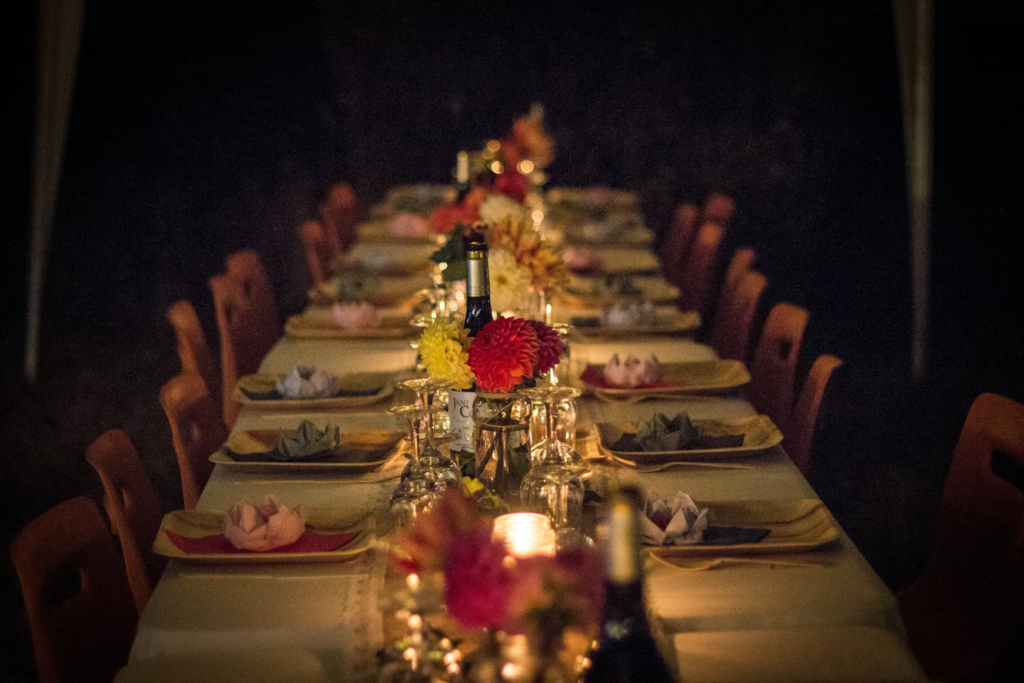
I am setting the table for Christmas dinner. It’s not a long, cold glass table in a sterile mansion. It’s a round oak table in a dining room painted yellow.
The doorbell rings.
I open it. Maria is there, holding little Dorothy, who is wrapped in a red coat. Behind her are two of the scholarship students, young women who call me “Grandma D.” One is studying nursing; the other is going to be a math teacher.
We hug. There is no fear at this door. No poison in the soup. No secrets.
We sit down to eat. The conversation is loud and messy and full of laughter. We talk about grades, about boys, about the future. We pass the potatoes and the gravy.
Midway through the meal, my phone buzzes in my pocket. I check it instinctively.
It’s a notification from the California Department of Corrections. A standard automated update about Marcus’s appeal status.
Appeal Denied.
I look at the screen for a second. I picture him in his cell, surrounded by concrete, stewing in his own bitterness, convinced the world robbed him. He is still writing letters, blaming me, blaming the system, blaming everyone but himself.
I turn the phone off and slide it into a drawer.
I look back at the table. At Maria, who saved my life. At the young women who are building their futures with the money Marcus tried to steal. At little Dorothy, who is smearing cranberry sauce on her face.
“Who’s hungry for pie?” I ask.
“Me!” little Dorothy shouts, raising her sticky hands.
I smile. The food is safe. The love is real. And for the first time in a very long time, I am home.
Let us know what you think about this story on the Facebook video! If you like this story, share it with friends and family.
