Michael Phelps isn’t just a name etched in the record books — he is widely regarded as one of the greatest athletes in Olympic history.
A figure who has captivated fans around the world not just for his athletic achievements.
But for his personal story, his resilience, and the meaningful life he’s built beyond competitive swimming. Phelps’s athletic career is nothing short of spectacular. With an unprecedented 28 Olympic medals, including a record 23 golds, he holds more Olympic medals than any other athlete in history — male or female.
That remarkable total leaves him far ahead of other sporting greats and in a category all his own in discussions about the most decorated Olympians of all time.
But beyond the medals, it’s his journey — from a young boy with big dreams in Baltimore to a devoted husband and father — that continues to inspire millions.
A Champion Is Born: Early Life and Olympic Dominance
Michael Fred Phelps was born on June 30, 1985, in Baltimore, Maryland, where his love of water first took shape. As a child, he struggled with attention‑deficit hyperactivity disorder (ADHD) and originally resisted getting his face wet — an irony considering his future.
But his mother enrolled him in swimming lessons, and what began as a way to manage his energy would eventually transform into one of the most decorated athletic careers of all time.
Phelps’s Olympic story spans five Games — from Athens 2004 through Rio 2016 — and his performances consistently re‑shaped what was thought possible in competitive swimming.
He dominated virtually every stroke and distance he entered, from butterfly to individual medley to relay events. His extraordinary physical gifts — including a tall frame, long wingspan, and incredible lung capacity — were matched by an unmatched work ethic and competitive drive.
At the 2008 Beijing Olympics, Phelps achieved a feat that had seemed unthinkable: eight gold medals at a single Games.
He continued to amass gold and set world records through subsequent Olympics, earning not just admiration, but a place in sporting history as the most decorated Olympian ever.
Yet Phelps’s greatness wasn’t built solely on natural ability — it was forged through relentless training, intense focus, and a willingness to push himself beyond limits that most athletes never approach.
Beyond the Medals: A Human Story
While his medal count is unmatched, Phelps has been equally open about the emotional and mental toll that life in elite sport can exact.
After the 2012 Olympics, he experienced one of the lowest points of his life; he spoke openly about feelings of despair, isolation, and lack of purpose once competition was over.
That period was one of the catalysts for his decision to seek help and speak publicly about mental health — a topic that was once taboo among elite athletes.
Phelps made it clear that athletic achievement doesn’t insulate anyone from emotional struggle. Instead, he chose to turn his experience into advocacy, encouraging others to speak out and seek support.
As he told Today in a candid interview about his life and family, Phelps said, “My depression and my anxiety aren’t going to just disappear,” but that through support and openness, he could manage them constructively.
Personal Life: Marriage and Family
While Phelps’s accomplishments in the pool have earned him global recognition, his life outside of the spotlight has also drawn admiration — especially his relationship with his wife, Nicole Johnson.
Nicole Johnson first entered the public eye as a beauty pageant competitor, winning Miss California USA in 2010 and earning runner‑up honors in the Miss California National Teenager competition earlier in her teens.
She later pursued modeling and, more importantly, became a steadfast partner to Phelps.
Though their relationship began before his final Olympic appearances, it continued to deepen and evolve even after his retirement from competitive swimming.
The couple first met years before they married, and after a proposal in 2015, they wed on June 13, 2016, in a private ceremony in Paradise Valley, Arizona.

Their wedding was not widely publicized at the time, but the couple later shared the news with fans, marking a new chapter in Phelps’s life — one increasingly rooted in family and shared experience.
Raising Four Sons: Boomer, Beckett, Maverick and Nico
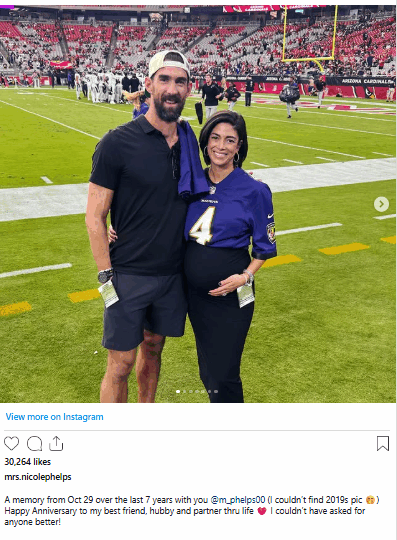
Today, Michael and Nicole Phelps are parents to four sons — Boomer, Beckett, Maverick, and Nico — and family life plays a central role in their daily routines and priorities.
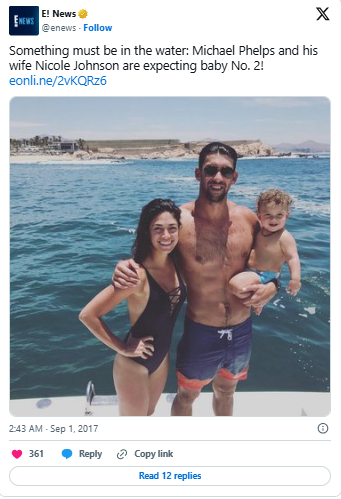
Their first son, Boomer Robert, was born on May 5, 2016, during the buildup to Phelps’s final Olympics in Rio, and was even present to witness his father win additional medals.
Their second son, Beckett Richard, arrived in 2018, followed by Maverick Nicolas in 2019, and their youngest, Nico Michael, in January 2024.
The addition of Nico brought even more joy to the family and completed their household with four energetic boys.
Despite the demands of public life, the Phelps family values shared traditions and normalcy. One of Michael’s cherished family memories involves their regular 5 p.m. dinner ritual, where they make time for connection and conversation each evening — something he says meant a great deal to him as a child growing up in a household with divorced parents.
Nicole has spoken candidly about how they parent — teaching their children that it’s okay to feel emotions, to ask for help, and to communicate openly.
Their approach to raising their boys intentionally fosters emotional intelligence and resilience. As Nicole said in a thoughtful interview, they strive to let their children know that their feelings are valid and that they shouldn’t hide them — a lesson that extends from Michael’s own personal journey.
Life After Competition: Advocacy and Purpose
Since retiring from competitive swimming after the 2016 Rio Olympics, Phelps’s focus has shifted from medals to impact.

He founded the Michael Phelps Foundation, an organization dedicated to expanding water safety, promoting healthy living, and building confidence in young people — causes that reflect his lifelong connection to the water and his desire to give back to the community.
But perhaps the most significant part of his post‑Olympic legacy is his work around mental health advocacy.
Phelps speaks openly about his battles with anxiety and depression — particularly the sense of emptiness that followed his greatest triumphs — and he uses his platform to normalize conversation about emotional struggles. He encourages others to seek help, reminding people that vulnerability is a strength, not a weakness.
In interviews, he credits his wife Nicole with being a cornerstone of his support system, calling her the “glue that holds us together.”
Her presence has been invaluable in helping him navigate personal challenges and maintain balance in family life.
Public Reception and Fan Admiration
Phelps’s fame stretches far beyond his Olympic gold medals. On social media platforms like Instagram, fans regularly celebrate his career, his humility, and his family life.
Admirers often express deep respect for his achievements, while others share more personal sentiments — describing him as an inspiration, an idol, or even sharing playful expressions of admiration.
Similarly, Nicole has gained her own following, with fans praising her grace, beauty, and supportive partnership.
Many comments describe her as “absolutely beautiful” and commend the couple for showing a relatable and grounded family life despite enormous fame.
What sets the Phelps family apart is not just athletic prowess, but authenticity: they showcase real life — complete with joy, struggle, intimacy, and emotional growth — and they do so in a way that resonates with people from diverse backgrounds who face their own challenges and victories every day.
A Legacy of Impact, Both in and Out of the Pool
When people discuss the greatest Olympians of all time, names like Usain Bolt, Carl Lewis, and Nadia Comăneci often come up because of their remarkable achievements and influence in their respective sports.
But in terms of pure medal count, Phelps stands alone — his Olympic record unmatched by nearly any athlete in sport history.
Yet for Phelps himself, life is about more than accolades. He has often said that his identity now includes being a husband, a father, an advocate, and a mentor — roles that are just as meaningful to him as his time on the world stage.
His journey from young swimmer to global icon, and from competitive athlete to devoted family man, reflects a broader lesson: that success is not defined solely by trophies, but by the way we show up in the lives of others.
In embracing both his triumphs and his struggles, Michael Phelps offers a powerful example of resilience, humility, and purpose — inspiring not only future athletes, but anyone striving to find their own balance between ambition and authentic living.
