The notification on my phone screen didn’t look like a threat. It arrived at 8:14 PM, just as the dishwasher began its rhythmic, chugging cycle—a sound that usually signaled the end of the day’s chaos. It was a standard generic typeface, the kind used for utility bills, school newsletters, or late payment warnings. But the sender’s address—”Riverton Property Management”—made my breath hitch in my throat.
“Regarding the incident outside the grocery store.”
I stared at the words, the glow of the screen seemingly brighter in the dim light of the kitchen. The email had been sitting there for nearly an hour, unopened. It wasn’t that I hadn’t noticed it; it was that I had noticed it too much. My heart hammered a nervous, erratic rhythm against my ribs, a physical manifestation of the anxiety that had become my constant companion over the last two years.
My son Micah’s sneakers were kicked off by the door, one lying on its side, the laces a tangled mess of mud and fraying aglets. Nova’s pink backpack was slumped against the wall, open, spilling out a crushed permission slip and a half-eaten granola bar. These were the mundane artifacts of our life—a life I had fought tooth and nail to stabilize after Nathan died.
I lived directly above that grocery store. We had been here for six years. I knew the ecosystem of this block better than I knew the lines on my own face. I knew the rhythmic clack-whoosh of the automatic doors opening, the heavy rumble of the delivery trucks at 4:00 AM that shook the floorboards beneath my bed, and the specific days the produce manager discounted the bruised apples. It was a delicate ecosystem I was part of, a fragile balance of commerce and community. Nothing “incidental” ever happened there without rippling upward into my living room.
I hovered my thumb over the email app, my finger trembling slightly, then locked the phone and set it face down on the counter.
A week earlier, I had made a small, quiet decision. It was a moment of impulse, born of grief and a sudden, piercing empathy. Now, standing in my kitchen with the hum of the refrigerator filling the silence, I felt the cold dread that perhaps my small act of kindness had unraveled the fragile security I had built for my children.

The Architecture of Grief
After Nathan passed, the concept of “home” changed. It was no longer a place of shared dreams or future plans; it became a fortress. I moved through my days with a rigid intentionality, not because I felt strong, but because I had an audience.
Micah, at ten years old, had developed a watchful gaze that unnerved me. He had his father’s eyes—a deep, contemplative hazel—and he used them to track my emotional state with the precision of a bomb disposal technician. He observed how long I stayed in bed on weekends; he tracked the tone of my voice when I answered the phone; he watched to see if I finished my dinner. He was looking for cracks in the foundation. He was waiting for the moment I might collapse so he could try, in his ten-year-old way, to catch me.
Nova, eight, was different. She was a barometer for atmospheric pressure. If I was anxious, she became clingy, attaching herself to my leg like a barnacle. If I was sad, she became manic and loud, singing songs from cartoons at the top of her lungs to drown out the quiet.
The apartment above the market wasn’t a palace. The radiator clanked like a dying engine, the water pressure in the shower was temperamental, and the floorboards in the hallway groaned underfoot. But it was ours. It was close to the kids’ school and three blocks from the dental office where I worked as a receptionist. It was the only home Nova remembered.
My mother, in her well-meaning but suffocating way, called it “temporary housing.”
She would come over on Sundays, her heels clicking disapprovingly on the hardwood, and run a finger over the windowsill. “You deserve to land somewhere peaceful, Melissa,” she would say, eyeing the peeling paint. “You’re a widow and a single mother. You shouldn’t be living above a deli where people loiter. It’s not… dignified.”
“Peace looks different now, Mom,” I’d reply, stirring sugar into my tea until it dissolved, much like my patience. “Peace is rent I can afford alone. Peace is the kids knowing where the bus stop is.”
But the true anchor of our home, the thing that made it feel like us rather than just a rental unit, was the coat rack in the entryway. Specifically, the dark gray wool jacket hanging on the far left hook.
It was Nathan’s. It was a heavy, field-style coat, lined with a quilted interior that used to trap his body heat. It had been hanging there since the day he stopped wearing it—since the day he went to the hospital for what we thought was a routine check-up and never came back. The coat preserved the shape of his shoulders in the stiff fabric. It held the ghost of his posture.
Micah would sometimes slip his arms into it when he thought I was busy with laundry. I would watch him from the reflection in the hallway mirror, seeing my little boy drowning in the dark wool, trying to inhabit the space his father left behind.
“Does it still smell like Dad?” he asked me once, months ago, his voice small, trying to sound casual.
I had paused, folding a towel, my heart aching with a physical sharp pain. “A little. Why, son?”
“I just wanted to check,” he said, shrugging those little shoulders that were trying so hard to be big. “I don’t want to forget the smell. Like… woodsmoke and mint gum.”
Nova was less subtle. She would bury her face in the sleeve on her way out the door, inhaling deep, as if the wool contained a secret code from her father, a message meant only for her. I never told them to stop. We were all just trying to breathe him in, terrified that one day, the scent would fade entirely, and he would be truly gone.
But on that Tuesday, the jacket became something else. It transformed from a relic into a lifeline.
The Tuesday Everything Changed
The morning had started with the usual chaotic symphony of single-parent life.
“Mom, I can’t find my blue folder!” Micah shouted from the living room, the panic of a perfectionist rising in his voice. He was tearing through his backpack, tossing papers onto the floor.
“It’s probably under the couch, honey,” I called back, scrubbing dried oatmeal off a bowl in the sink. “Check where you were sitting last night when you were doing your math.”
Nova was doing a pirouette by the door, her coat half-zipped, her hair a tangled halo of static. “Grandma is picking me up today, right? She promised we could get ice cream.”
“Yes, baby. She’ll be here in ten minutes. You know Gran, she’s never late. And don’t fill up on sweets before dinner.”
And she wasn’t late. My mother swept in like a weather front, bringing a gust of expensive perfume and critical energy. She kissed cheeks, straightened collars, and lectured Micah on his nutrition all in one breath.
“You’re a growing boy, Micah. You look pale. You need meat and veggies. No more sugary cereal, Melissa,” she said, shooting a look at the box on the counter.
“Yes, Gran,” he said, flashing a smile that didn’t quite reach his eyes. He knew how to navigate her.
When the door clicked shut and silence reclaimed the apartment, I exhaled, leaning against the counter for a moment of stillness. The quiet was both a relief and a burden. Without the noise of the children, the apartment felt vast and empty.
I grabbed my reusable canvas bags. I needed milk, bread, and something for dinner that didn’t require much thought—pasta, maybe. I headed downstairs, stepping out of the warmth of the stairwell and into the biting reality of November.
The wind cut through my sweater the moment I stepped onto the sidewalk. It was a bitter, damp cold—the kind that settles in your joints and makes your teeth ache. It was an unseasonably harsh day, the sky a bruised purple-gray.
That was when I saw him.
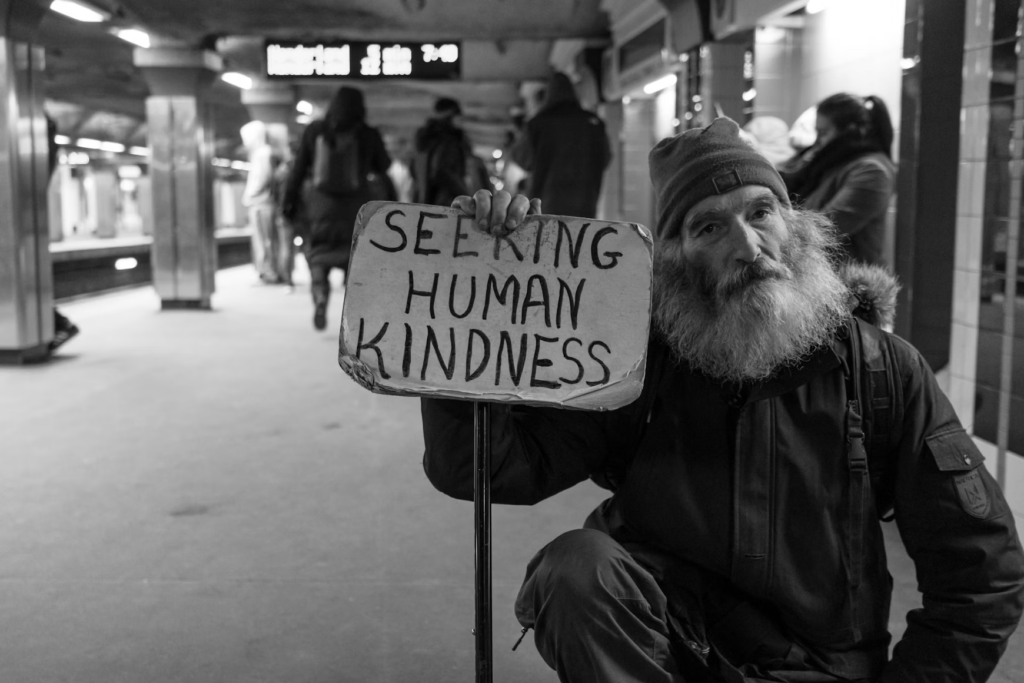
He was tucked into the alcove where the brick wall met the glass storefront of the grocery store, positioned carefully so he wouldn’t obstruct the automatic doors. He wasn’t aggressive. He wasn’t shouting at passersby. He was just sitting.
His knees were pulled to his chest, his arms wrapped tightly around them in a desperate attempt to conserve heat. A cardboard sign, softened by moisture and illegible at the edges, leaned against his hip.
“Veteran. Anything helps. Please.”
I had seen homeless men in the neighborhood before. It was a city; people fell through the cracks. Usually, I offered a polite, distant nod and kept moving, my mind on my own survival, my own grief. But this man was shivering. Visibly, violently shivering. The tremors ran through his body in waves.
He wore a thin, pilled knit sweater that looked like it belonged in a donation bin, completely inadequate for the forty-degree weather. The elbows were worn through. He had no hat. No gloves. His ears were a bright, angry red.
I slowed down. I couldn’t help it. The sight of his vulnerability pierced through the armor I wore to get through the day.
He looked up. His face was weathered, lines etched deep around his eyes like riverbeds, skin chapped by the wind. But his eyes were clear, alert, and startlingly blue. He looked like a man who had spent a long time waiting for something that wasn’t coming.
“Ma’am,” he said. His voice was gravelly but soft, lacking the aggressive edge I sometimes encountered on the street. “I’m sorry to bother you. It’s… it’s colder than I expected today. Do you have any change to spare? Just for a coffee?”
I hesitated. My hand went to my pocket, but I didn’t have cash. I rarely did anymore; everything was cards and apps.
“I’m a veteran,” he added, tapping the soggy sign. “Just trying to get through the week.”
I looked at his hands. They were raw, the knuckles cracked and bleeding slightly where the dry skin had split. He tucked them back under his armpits quickly, ashamed of the weakness, ashamed of the cold.
I thought of Nathan. I thought of the stories he told me about the mountains in Afghanistan, the cold that felt like it had teeth. He used to say, “You can handle fear, Mel. You can handle bullets. But the cold… the cold takes your mind. It makes you slow. It makes you give up.”
“You should have a coat,” the words left my mouth before I processed them. It sounded like an accusation, a stupid statement of the obvious, and I immediately regretted the tone.
He gave a dry, humorless laugh that turned into a cough. “I know. Got stolen two nights ago while I was sleeping. Hazards of the trade.”
I looked at him—really looked at him. He wasn’t just a statistic. He was a human being freezing on my doorstep.
I made a decision. It was terrifying and simple all at once.
“Wait here,” I said, my voice firm. “Don’t move. I mean it.”
The Weight of Wool
I ran back up the stairs, taking them two at a time, my heart pounding in my ears. The apartment was silent. I walked straight to the entryway and stopped dead.
There it was. The gray wool jacket.
It was a museum piece. It was a shrine. It was the only thing in the house that still held the physical shape of my husband. To move it felt like erasing him. It felt like admitting he wasn’t coming back to claim it.
I reached out and touched the fabric. It was scratchy and durable. I thought of Micah wearing it, drowning in it. I thought of Nova smelling it, closing her eyes to find her father in the dark.
But then I thought of the man downstairs, his knuckles bleeding in the wind. I thought of Nathan.
Nathan, who brought stray dogs home. Nathan, who spent his weekends fixing the widow Mrs. Higgins’ fence down the street. Nathan, who would have given the shirt off his back to a stranger without a second thought because he believed that strength was given to you so you could carry things for people who couldn’t.
If I kept the jacket here, gathering dust, I was worshipping the object, not the man. I was hoarding the warmth he had left behind, while a brother-in-arms froze fifty feet below me.
“He wouldn’t want it hanging here,” I whispered to the empty hallway. “He’d hate that.”
I took it off the hook. It was heavy in my arms, weighing as much as a memory. A faint waft of peppermint and old cedar rose from the fabric.
I ran back downstairs before I could change my mind. Before the selfish part of my grief could stop me.
The man was still there, looking skeptical, his head tucked down. When he heard the door open, he looked up. When he saw what I was holding, his eyes widened. He looked from my face to the gray wool in my hands, and I saw a flicker of disbelief.
“It’s clean,” I said, breathless, thrusting it toward him. “And it’s warm. It’s wool. It handles the wet well.”
He didn’t reach for it immediately. He pulled back slightly, as if he wasn’t sure he was allowed to touch it. “I can’t take that, ma’am. That looks… that looks like a nice coat. That belongs to someone. I can’t take a man’s coat.”
“What’s your name?” I asked.
“Paul,” he said.
“Well, Paul, it used to belong to someone. Someone who hated the cold. But it isn’t doing anyone any good hanging in a hallway while you freeze to death.”
He looked at the jacket, then at me. I saw his throat work as he swallowed. He saw the quality of it. He knew what this was worth.
“I just don’t want to cause trouble,” he whispered. “If the police see me in this…”
“You won’t cause trouble. I promise. It’s a gift. Please. Take it.”
He stood up, his movements stiff and agonizingly slow from the cold. He reached out with those cracked hands and took the heavy wool. He slid his arms into the sleeves. It wasn’t a perfect fit—Nathan had been broader in the chest—but it wrapped around him, covering those thin, pitiful layers. He buttoned it with trembling fingers, pulling the collar up around his neck.
The transformation was instant. He stood straighter. The shivering began to subside.
He looked at me, and his eyes were wet, bright with unshed tears. “Thank you,” he choked out. “I won’t forget this. I swear.”
I went inside the store, bought him a hot soup and a loaf of bread, and handed them to him on my way out. I didn’t stay for a long conversation. I couldn’t. The emotions were too high, too raw.
I went upstairs and cried in the bathroom for ten minutes, the empty hook in the hallway mocking me.
The Phantom Limb
The days that followed were filled with a strange, hollow tension.
That first night, the inevitable happened.
“Where’s Dad’s jacket?” Micah asked. He was standing in the hallway, his backpack slung over one shoulder, pointing at the empty hook.
My stomach dropped. I had rehearsed this, but the reality was harder. “I loaned it to someone who needed it, baby. Okay?”
He stared at the empty space. He looked at me, his eyes narrowing, processing the information. I braced myself for a meltdown. I braced myself for him to scream that I had given away his father, that I was erasing the last pieces of him.
Instead, he walked over to the hook and touched the wood where the coat used to hang.
“Who needed it?” he asked quietly.
“A man outside. A soldier, like Daddy. He was very cold.”
Micah thought about that. He looked at his own warm hands. Then he nodded slowly. “That sounds like something Dad would do. He always gave his gloves away.”
I exhaled a breath I didn’t know I was holding. “Yeah. He did.”
Nova was harder. She didn’t ask; she just noticed. For two nights, she had trouble sleeping. She wandered into my room at 2 AM, clutching her stuffed rabbit.
“I can’t smell him,” she whispered, climbing into my bed. “The hallway just smells like cleaning spray.”
“I know, baby,” I soothed, stroking her hair. “But Daddy isn’t in the coat. He’s in here,” I pressed my hand to her chest. “And he’s in the stories we tell.”
“I liked the coat though,” she mumbled, drifting off.
I felt a pang of guilt so sharp it nearly doubled me over. Had I prioritized a stranger over my children’s comfort? Was my mother right? Was I making reckless decisions because I was too steeped in my own need for redemption?
The doubt grew when I ran into Mrs. Gable from 3B in the stairwell on Thursday.
“Melissa,” she said, clutching her purse. “I saw a vagrant outside wearing a very expensive-looking jacket. It looked… well, it looked familiar.”
“I gave it to him, Mrs. Gable,” I said, trying to keep my voice even.
Her eyebrows shot up. “Oh. Well. That’s very… generous. But you know, encouraging them to stay around the building… the management doesn’t like it. It makes people uneasy.”
“He’s a veteran, Mrs. Gable. He’s not dangerous.”
“They’re all veterans, aren’t they?” she sniffed, stepping around me. “Just be careful. You don’t want to attract the wrong attention.”
Her words gnawed at me. The wrong attention. I was a single mother living in a rent-stabilized apartment. I walked a tightrope every day.
And then, the email came.

The Inquiry
Now, staring at my phone, Mrs. Gable’s warning felt like a prophecy.
“Regarding the incident…”
Panic is a cold water rising. Had I broken a rule? Was soliciting prohibited? Was I aiding a nuisance? We couldn’t afford to move. The rent here was half of what a new place would cost. If we were evicted… if I lost this safe harbor…
I finally clicked the email. The text was formal, corporate, and terrifying.
“Dear Melissa C.,
We are contacting you regarding an incident reported outside the grocery store located beneath your residence. Building policy prohibits residents from engaging in unauthorized interactions that may impact tenant safety or building operations. During a welfare check by local authorities, the individual involved referenced receiving personal property from a resident at your address.
Please contact Facilities Management immediately to clarify your involvement.”
I read it three times. The words “unauthorized interactions” and “welfare check” stood out like neon warning signs.
“Clarification,” I whispered to the empty room. “That never sounds good.”
I paced the kitchen. I looked at the kids’ drawing on the fridge. I looked at the bills on the counter. I felt small. I felt like the widow who couldn’t handle things.
I called my mother. I needed to hear a voice that wasn’t my own internal panic.
“Did you break a rule?” she asked immediately after I explained, her voice tinny through the speaker. Her tone was practical, cutting through the emotion.
“I don’t think so, Mom. I just gave a freezing man a jacket. Since when is charity a lease violation?”
“In this city? Since always, Melissa. People don’t like it when you encourage loitering. I told you that neighborhood was tricky.”
“He wasn’t loitering, he was dying of hypothermia!” I snapped, surprising myself.
“Okay, okay. Calm down. Just call them,” she advised, softening. “Be polite. Apologize if you have to. Play the confused widow card if you need to. Just don’t lose the apartment over a coat.”
“I hate that you called it a card, Mom.”
“It’s survival, Melissa. Do what you have to do.”
I hung up. I washed my face with cold water. I looked at myself in the mirror. I looked tired. But I saw Nathan’s determination in my jaw.
I dialed the number at the bottom of the email. My hand was shaking, but my voice was steady.
A woman answered on the second ring. “Riverton Facilities Management, this is Brenda.”
“Hi, Brenda. This is Melissa… from the apartment above the market on 4th. I got an email about an incident? I wanted to clear it up immediately.”
There was a pause, the sound of typing. “Ah, yes. Melissa. Thank you for calling so quickly.”
“I’m sorry if I caused a problem,” I said, the words tumbling out before I could stop them. “I just saw a veteran who was cold, and I gave him an old coat. I didn’t know it was against policy to help someone. He wasn’t bothering anyone.”
“Melissa, stop,” Brenda interrupted. Her voice had changed. It wasn’t the corporate drone anymore; it was softer, human. “You aren’t in trouble.”
I blinked, leaning against the wall. “I’m… I’m not?”
“No. We have to send those emails for liability reasons whenever police or social services are involved on the property. But the report… well, it wasn’t a complaint.”
“Police were involved?” My heart started racing again.
“A welfare check,” she clarified. “Social services came by—the VA outreach team. They were trying to get the man, Paul, into a shelter. They noticed the jacket. It’s a very high-quality coat, Melissa. Military grade. They thought he might have stolen it from a tenant.”
I gasped. “Oh no. He didn’t steal it.”
“He told them that,” Brenda continued. “He was very adamant. He made them take your name down and check the buzzer so you wouldn’t get in trouble if they came asking. He refused to go with them until they promised not to harass ‘the lady in 2A’. He was cooperative. No charges, obviously.”
“Is he okay?” I asked, sliding down the wall to sit on the floor.
“Yes. Actually… he asked if we could pass a message to you. That’s why I flagged the email personally.”
“What message?”
“He said thank you. And he said…” Brenda paused, rustling a paper. “He said he served with Nathan. He recognized the name.”
The phone nearly slipped from my sweaty hand. The kitchen tilted on its axis.
“My husband?” I whispered. “He knew Nathan?”
“Yes. He said he saw the name tape on the inside lining. Nathan C. He said they were in the same unit overseas. The 10th Mountain Division? Does that sound right?”
“Yes,” I choked out. “That’s right.”
“He wanted you to know that seeing that jacket… he said it saved him. And not just from the cold.”
I sat in the stunning silence of my kitchen, tears streaming down my face. Nathan. Even gone, he was still doing the work. He was still looking out for his guys. The coat hadn’t just been wool and stitching; it had been a signal fire.
“Thank you, Brenda,” I managed to say. “Thank you for telling me.”
“You’re a good person, Melissa. We need more of that.”

The Return
Two days later, on a Thursday afternoon, the sky was clear and crisp. I was helping Micah with fractions when the buzzer rang.
I looked at the intercom. It was Paul.
I buzzed him in and walked to the hallway outside my door, leaving the chain on just in case—old habits die hard. But when he appeared at the top of the stairs, I opened the door fully.
He looked different. He was shaved, his jawline sharp and clean. He was wearing clean clothes—generic khakis and a flannel shirt—but he looked like a person again. He stood upright, his shoulders back.
And draped over his arm, neatly folded, was the gray wool jacket.
“I wanted to return this,” he said as I stood there.
“You didn’t have to,” I said, my throat tight. “I gave it to you.”
“I know,” Paul said, a small smile touching his lips. “And it did its job. But I’m not out there anymore.”
He gestured to his clean clothes.
“The VA shelter took me in,” he explained. “When the outreach team saw the jacket… when they saw Nathan’s name… they made some calls. Turns out, your husband was a bit of a legend in our battalion. He was the guy who organized the supply runs for the local schools over there. Everyone knew him.”
He paused, looking down at the coat.
“They treated me differently because I was wearing it. They stopped seeing a bum and saw a soldier again. They got me a bed. They’re getting me into a job placement program next week. Security work.”
I reached out and touched the wool. It smelled faintly of woodsmoke now, and the city, and cheap soap, but underneath, it was still Nathan.
“Your husband helped me once, years ago,” Paul said softly, looking me in the eye. “I was a nervous kid on my first deployment. He found me shaking behind a Humvee before a patrol. He didn’t yell. He just handed me a stick of gum and said, ‘Breathe, kid. We all walk back together.’ He made sure we didn’t lose ourselves.”
Tears pricked my eyes. That was him. That was exactly him.
“When I put this coat on,” Paul continued, his voice thick with emotion, “it felt like he was telling me to get my act together. Like he was spotting me one last time. I couldn’t let him down.”
He handed the jacket to me.
“He would have liked what you did, ma’am. He always believed we had to look out for each other.”
I took the jacket. It felt heavier now, loaded with a new story. “Thank you, Paul. For telling me. Good luck.”
“You too, Melissa. You’ve got a good heart. Don’t let the world freeze it out of you.”
He turned and walked down the stairs, his step lighter, a man with a future again.
I walked back into the apartment. Micah was standing in the doorway of the living room. He looked up and saw the bundle in my arms.
“It’s back,” he said, his eyes widening.
“Yes,” I said, walking to the coat rack. “It’s back.”
I hung it on the far left hook.
Nova ran into the room, stopped, and stared. She walked over, buried her face in the sleeve, and inhaled deeply.
“Does it still smell like Dad?” Micah asked, coming to stand beside her.
Nova pulled back, wrinkling her nose. “It smells like outside,” she said. Then she smiled, a genuine, bright smile. “But it feels like Dad.”
I looked at the empty hook that was no longer empty, and I realized something. The grief was still there—it would always be there—but the fear was gone. The apartment didn’t feel like a fortress anymore. It felt like a home.
Kindness wasn’t fragile. It wasn’t a risk that jeopardized our safety. It was the strongest thing we had. It was a tether that connected us to the past, and to the people walking in the cold below us, and to the future we were trying to build.
Nathan was gone, but he was still here. He was in the kindness of strangers, in the second chances, and in the gray wool coat hanging by the door. And as long as we were willing to open the door, he always would be.
We’d love to hear your thoughts. Did this story resonate with you? Have you ever had a small act of kindness return to you in an unexpected way? Let us know what you think about this story in the comments on the Facebook video.
And if you like this story, please share it with friends and family—you never know who might be struggling in the cold today, needing a reminder that warmth is just one gesture away.
