Riddles have a special way of capturing our attention, especially when they seem simple at first but end up challenging our logical thinking. One such brain teaser has been making the rounds online, leaving many scratching their heads. The question is deceptively straightforward:
“If you had 4 eggs, a thief gives you 3, and your rooster lays 5, how many eggs do you actually have?”
At first glance, it might appear to be a basic math problem. But here’s the twist—it’s not about numbers; it’s about logic. Let’s dive into this viral riddle and break it down step by step to reveal the real answer.
The Puzzle: A Question That’s Not What It Seems
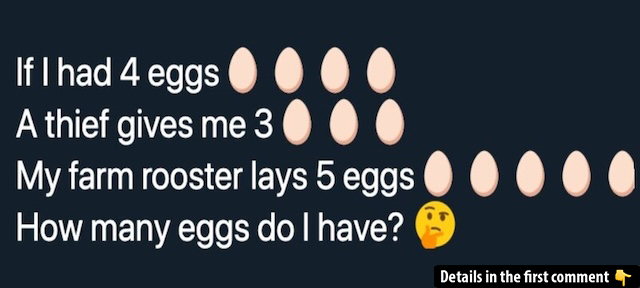
Here’s the riddle in full:
“If I had 4 eggs, a thief gives me 3, my farm rooster lays 5 eggs, how many eggs do I have?”
It sounds simple enough, right? But the trick lies in the phrasing and the layers of logic embedded within each line. Many people get this wrong because they overthink or overlook key details. Before diving into the solution, take a moment to think about it yourself.
Common Mistakes People Make
The charm of this riddle lies in how easily it can trip you up. Here are the most common pitfalls:
- Taking “If I had 4 eggs” Literally
Many assume that they begin the riddle with 4 eggs. However, the phrase “if I had” introduces a hypothetical scenario. It’s not stating that you actually have 4 eggs; it’s just setting the stage for the riddle. - Believing Roosters Lay Eggs
Here’s where the riddle tricks even the most logical thinkers. Roosters don’t lay eggs—only hens do. This line is intentionally misleading, designed to make you question your understanding of biology. - Ignoring the Absurdity
A thief giving you eggs? That’s not exactly common behavior. This line adds an element of absurdity to the riddle, prompting you to think critically rather than accept everything at face value. - Overcomplicating the Math
It’s easy to start adding and subtracting numbers without stepping back to consider the logical inconsistencies. But riddles often play on our tendency to overthink.
Step-by-Step Breakdown of the Riddle
Let’s analyze the riddle line by line to uncover the truth.
“If I had 4 eggs”
This is a hypothetical statement. You don’t actually have 4 eggs at the start. The phrase “if I had” sets up an imaginary scenario, so this line contributes nothing to the final count.
“A thief gives me 3”
This part suggests you receive 3 eggs. While the idea of a thief giving instead of stealing seems far-fetched, let’s assume it happens. At this point, you have 3 eggs.
“My farm rooster lays 5 eggs”
This is where the riddle throws its biggest curveball. Roosters don’t lay eggs. They’re male, and egg-laying is biologically impossible for them. Therefore, this line adds nothing to the egg count and serves solely to mislead.
The Final Answer

By the end of the riddle, the only real eggs you have are the 3 given to you by the thief. The hypothetical 4 eggs and the rooster’s impossible contribution don’t count. The correct answer is 3 eggs.
Why This Riddle Captures Attention
The genius of this riddle lies in its ability to blend logical inconsistencies with everyday assumptions. It forces you to question what you know, from basic biology to the literal meaning of words. While it seems simple on the surface, the riddle challenges your critical thinking skills and your ability to separate fact from fiction.
What Makes Riddles Like This So Popular?
Riddles like this are so engaging because they’re fun and frustrating at the same time. They play on our natural curiosity and our desire to solve problems. They’re also great conversation starters, sparking debates among friends and family as everyone tries to prove they’re right.
Conclusion: Did You Crack It?
So, how did you do? Did this riddle stump you, or did you crack it right away? Whether you overthought it or figured it out instantly, the beauty of this puzzle lies in its simplicity and its ability to make you think critically. Riddles like this aren’t just entertaining—they’re a great way to sharpen your logical reasoning and problem-solving skills. Next time you come across a brain teaser, take a moment to pause, think it through, and enjoy the challenge.
