Ready to play detective? Let’s dive into this classic hidden object challenge that’s taking over the internet.
The Setup: A Chaotic Scene with Clever Camouflage
At first glance, the picture looks like pure clutter—random objects scattered without rhyme or reason. But this isn’t accidental. The image is designed to throw you off. Every line, shadow, and contrast has been placed to confuse your focus and disguise the very things you’re looking for.
And here’s the twist: it’s all in black and white, stripping away color cues and making it even harder for your brain to pick out familiar shapes. That means no bright yellow straw, no colorful sock. Just shades of gray hiding everything in plain sight.
The 30-Second Challenge: Are You Among the Elite 10%?
The rule is simple: You’ve got 30 seconds.
Find all four items before the timer runs out. If you do, you’ve got sharper eyes than most people out there. Why 30 seconds? Because it adds just the right amount of pressure to send your brain into overdrive. You’ll start scanning too quickly, second-guessing what you’ve already seen, and before you know it—time’s up.
Still confident? Don’t blink. The hunt begins now.
Why This Puzzle Is More Than Just a Game
On the surface, it’s just a fun brain teaser. But challenges like this one actually do something bigger. They teach us about how our brains work—and how they fail us sometimes.
Your brain loves shortcuts. It tries to recognize patterns and skip over what it thinks is unimportant. That’s great when you’re driving or walking through a familiar store. But in this case, it’s your biggest enemy.
These hidden object puzzles force you to slow down, look deeper, and question your assumptions. It’s not just about spotting things—it’s about un-training your brain from jumping to conclusions.
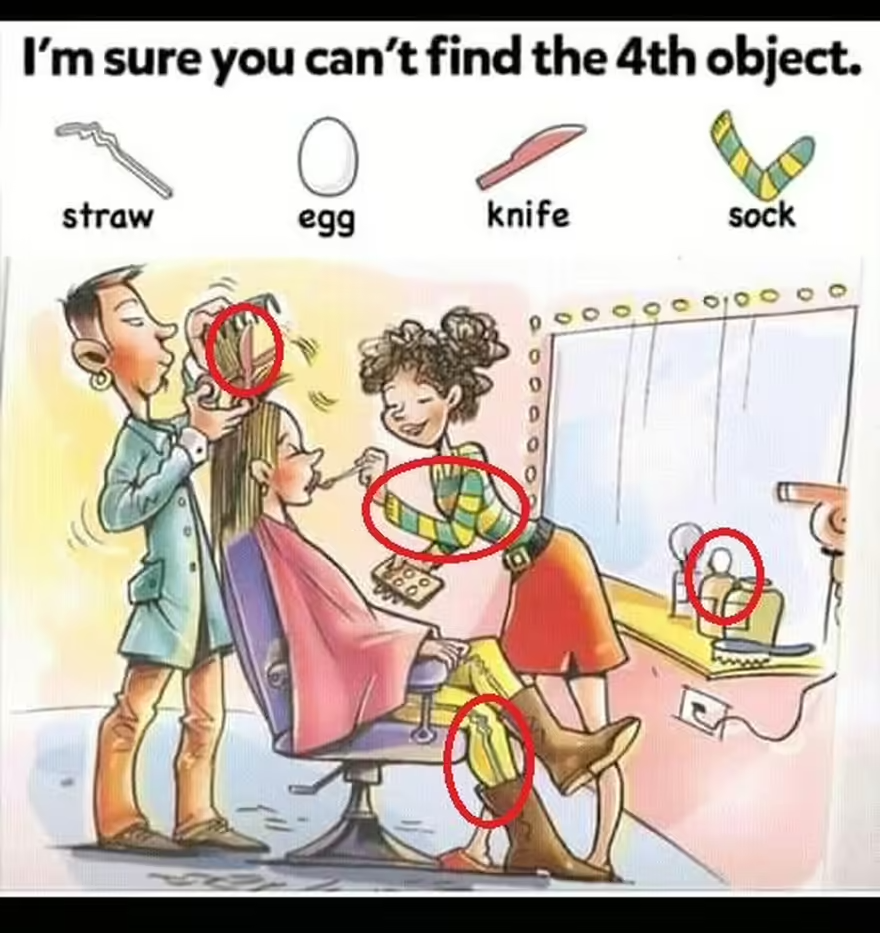
Clue Breakdown: What to Look For
Need a few hints? Here’s how to think about each object:
Straw – Look for something thin, long, and straight. It may be lying across another object or barely visible at the edge.
Egg – Smooth, round, and deceptively small. Could be nestled inside a bowl or hiding behind a curved shadow.
Knife – Metallic, straight-edged, and likely camouflaged against other kitchen tools or lines.
Sock – Look for texture and curves. Socks often blend in with cloth-like shapes or soft-edged objects.
Most people spot two or three. Very few spot all four—unless they zoom in and truly analyze the image.
The Psychology of Missing the Obvious
So why do we miss things that are right in front of us?
It all comes down to visual overload. When too much information hits our eyes at once, the brain starts to prioritize. It dismisses shapes that don’t immediately match what it expects a straw or egg to look like. That’s where this challenge gets you—by forcing your brain to work against its instincts.
It’s like losing your keys only to realize they’ve been in your hand the whole time. This puzzle plays the same trick—just on a more strategic level.
The Big Reveal: Where Were They Hiding?
Spoiler alert: if you’re still searching, stop reading now.
But if you’ve reached the point where you’re starting to question your sanity, here’s what you’ve been missing:
The Straw – Tucked diagonally across the edge of a plate, blending into a fork handle.
The Egg – Sitting in a shadowy bowl, partially covered by a spoon.
The Knife – Aligned perfectly with the edge of a cutting board, its blade disguised by the border.
The Sock – Crumpled near the bottom left corner, disguised as part of a dish towel.
Once you see them, you can’t unsee them. And you’ll probably ask yourself how you ever missed them in the first place.
Final Thoughts: Don’t Trust the Obvious
This puzzle is a perfect reminder that the things we overlook are often the most obvious ones—once someone points them out. It’s a metaphor for life, really. We’re so busy rushing from one thing to the next that we miss the little details. The small truths. The stuff hiding just under the surface.
So next time you scroll past a visual puzzle, don’t assume it’s easy. Take a deep breath. Tune into your surroundings. Because whether it’s a straw or a sock—or something much deeper—the things we’re looking for often require a second look.
And remember: in a world full of noise, sometimes the quietest details speak the loudest.
