The Tree of Faces Illusion: How Hidden Art Transforms Nature’s Canvas
Unmasking the Magic of Optical Illusions
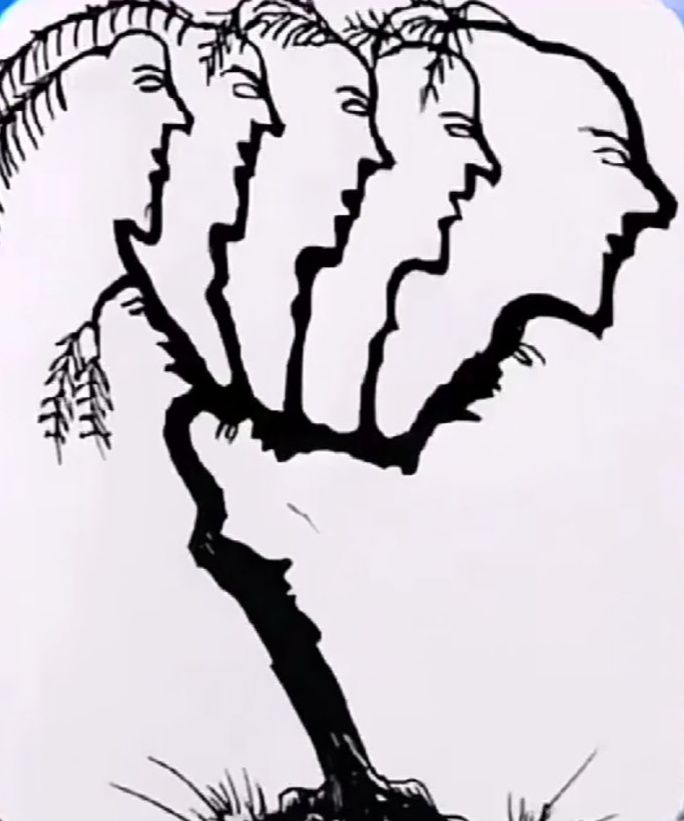
Have you ever glanced at a simple scene—like a gnarled tree trunk—and suddenly perceived something entirely different, such as multiple human profiles? That captivating moment is the power of an optical illusion at work. The “Tree of Faces” illusion merges organic forms with subtle artistic cues, coaxing our brains to see five distinct faces emerging from the branches. This phenomenon isn’t just a party trick; it reveals deep insights into human perception, creativity, and the way we interpret visual information. In this article, we’ll unravel the science, history, and techniques behind such hidden‐face illusions, and explore how you can train your eye to discover secret art in everyday environments.
Why Optical Illusions Fascinate Us
Optical illusions tap into the brain’s natural tendencies:
- Pattern Recognition: Our minds hunt for familiar shapes—faces, animals, letters—in random stimuli, a survival trait known as pareidolia.
- Top‐Down Processing: Expectations and experience shape perception. If you’re told there are faces in a tree, your visual system eagerly assembles them from scattered lines.
- Visual Ambiguity: When an image supports more than one interpretation, our brain flips back and forth between possibilities, a delightful cognitive dance.
These mental shortcuts helped our ancestors detect predators in foliage; today, they entertain and inspire artists, designers, and curious minds alike.
A Brief History of Hidden‐Face Art
Artists have long exploited pareidolia to create multi‐layered images:
- Renaissance Masters: Giuseppe Arcimboldo’s 16th‐century “espiritu” portraits—composed of fruits, flowers, and books—challenged viewers to decipher hidden likenesses.
- 19th‐Century Surrealists: Salvador Dalí and Max Ernst incorporated ghostly figures and faces into landscapes, encouraging dreamlike associations.
- Modern Graphic Designers: Today’s illustrators hide profiles in tree bark, cloud formations, and typographic art, leveraging digital tools to refine ambiguities.
Over centuries, hidden‐face art has evolved from lavish oil paintings to minimalist line drawings, yet the core thrill remains: discovering the unexpected within the ordinary.
Decoding the “Tree of Faces” Illustration
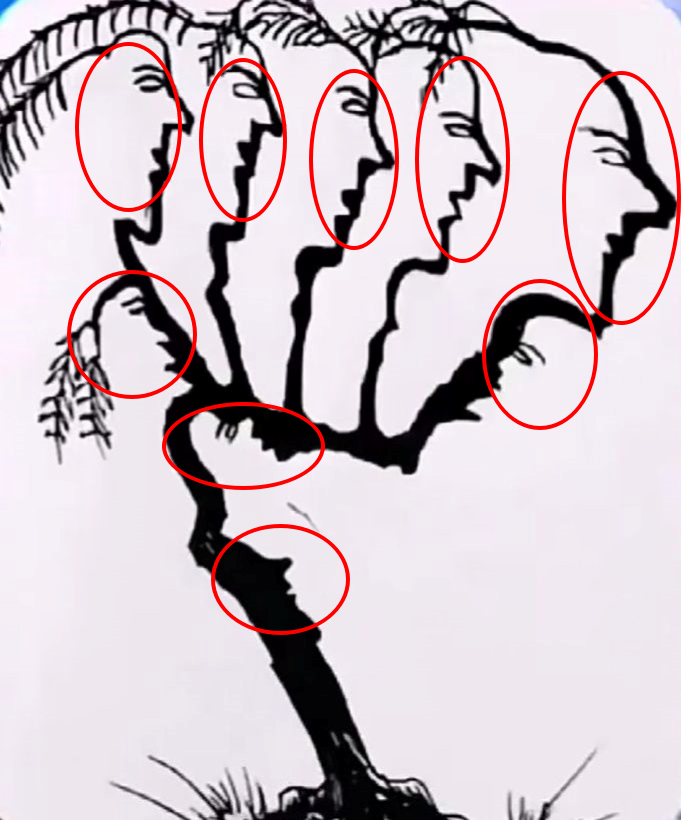
Let’s break down the five faces cleverly embedded in the tree branches:
- Profile One: On the rightmost branch, a full jawline and forehead curve form a clear silhouette—our anchor for spotting others.
- Sequential Overlaps: Moving left, each successive face shares contours with its neighbor, like a fanned deck of cards, exploiting negative space between branches.
- Unified Trunk: The tree’s trunk acts as a unifying “neck,” guiding your eye upward to the branching faces.
- Subtle Details: Wispy lines suggest hair and eyes; these minor flourishes transform mere branch intersections into convincing visages.
- Natural Symmetry: The artist chose a vantage point—slightly tilted—to mimic organic asymmetry, convincing your mind that this isn’t an art piece but a fortuitous natural wonder.
By understanding these tricks, you’ll sharpen your ability to spot hidden faces in other ambiguous images.
The Psychology Behind Pareidolia
Why does our mind insist on seeing faces everywhere?
- Social Brain Hypothesis: Humans are wired to prioritize facial recognition—detecting a face could mean knowing friend from foe, a crucial social skill.
- Minimal Information Needed: Just two dots (eyes) and a curve (mouth) often suffice for us to perceive a human face—our pattern detectors leap at any suggestive cues.
- Emotional Engagement: Faces carry emotional weight. Spotting a smiling or stern visage in a tree sparks narrative, curiosity, and a personal reaction.
Understanding these instincts reveals why illusions like the “Tree of Faces” feel simultaneously surprising and eerily familiar.
How to Train Your Eye for Hidden Art
Cultivating your illusion-spotting skills turns ordinary settings into wonderlands:
- Start With Simple Shapes: Practice on basic two‐tone sketches—dots and lines that resolve into faces when you squint or tilt your head.
- Scan Methodically: Divide a complex scene into quadrants. Look at each section for unusual contours or negative‐space patterns that mimic facial features.
- Adjust Perspective: Viewing from different angles—standing farther back, leaning in close, or tilting your head—can reveal new shapes.
- Use Lighting Tricks: Shadows and highlights accentuate certain lines. Shine a flashlight from the side or view images under soft natural light to coax out hidden forms.
- Create Your Own: Sketch a tree branch pattern, then deliberately draw subtle arcs and dots that evoke eyes, noses, and lips—experiment with how little information your brain needs to see a face.
With regular practice, you’ll begin to notice faces in clouds, building facades, and even kitchen clutter.
Applying Hidden‐Face Techniques in Design and Decor
Designers leverage these illusions to delight and surprise:
- Branding and Logos: Subtle silhouettes—like the hidden bear in the Toblerone mountain—create memorable, shareable designs.
- Interior Murals: Wall art that transforms under shifting light or vantage points adds dynamic character to living rooms or offices.
- Fashion Prints: Camouflage or geometric fabrics can incorporate silhouettes, intriguing observers with each glance.
- Augmented Reality (AR): Interactive filters overlay hidden faces onto real‐world scenes, inviting users to explore and share discoveries.
By weaving hidden faces into products and spaces, creators forge deeper engagement between their work and the audience’s imagination.
Conclusion: Seeing Beyond the Surface
The “Tree of Faces” illusion reminds us that perception is an active, creative process—our minds constantly assemble fragments into meaningful wholes. By recognizing the principles of pareidolia, studying historical masters, and practicing targeted observation techniques, you can unlock a new dimension of visual discovery. Next time you encounter a gnarled branch or a drifting cloud, pause and ask: “What else might be hiding here?” You may be surprised what smiles back.
