Are you ready to challenge your powers of observation? This brightly colored cartoon puzzle is the ultimate test for anyone who prides themselves on having sharp vision and a keen eye for detail. At first glance, the two images might look exactly the same, but look closer—there are 10 tiny differences hidden within the scene, and spotting them isn’t as easy as it sounds. This puzzle is designed to be deceptive, catching most people off guard by tucking small changes into areas we often overlook.
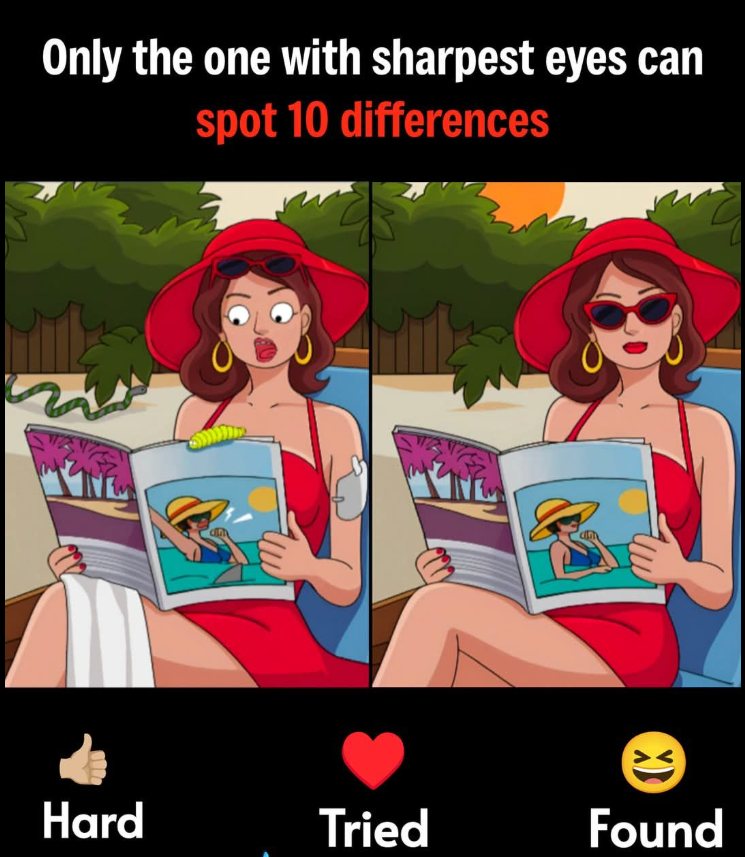
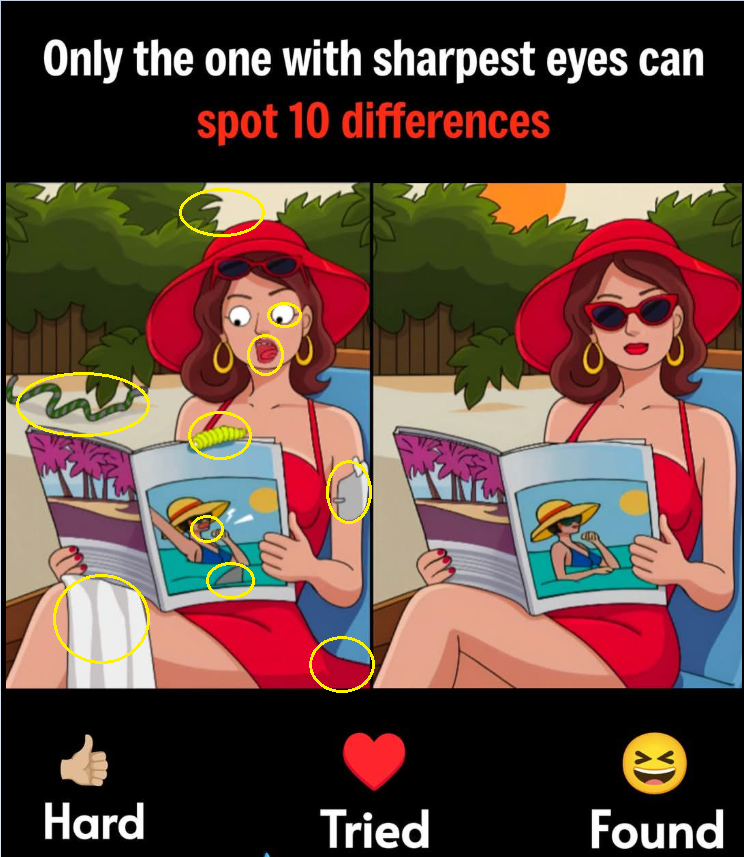
Many puzzle solvers fall into the trap of searching for large, obvious alterations, but in reality, the key to solving this brain teaser lies in focusing on the most subtle details—small color changes, slight shifts in position, or minor elements that disappear altogether. Our brains are naturally wired to assume that two nearly identical images are the same, which means we often miss the tiniest inconsistencies unless we deliberately slow down and examine every inch of the image. If you’re up for the challenge, take a good look before reading ahead. Zoom in, study the image carefully, and don’t let your brain play tricks on you. When you’re ready, here’s a breakdown of all 10 differences between the left and right images. First up, the sunglasses. In the left image, they’re sitting on top of the woman’s hat, but in the right image, she’s wearing them instead.
Then there’s the shape of her lips—on the left, her mouth is wide open in surprise, while on the right, she’s calmly smiling with her lips closed. In the background of the right image, an orange sun peeks through the palm leaves, but this detail is missing in the left version. If you check the magazine cover, you’ll notice the woman on the front is sitting upright in the left image but lying down in the right. A small green caterpillar crawls across the magazine in the left image, while it’s nowhere to be found in the right. Moving to her right arm, she’s wearing a white armband in the left image, which completely vanishes in the right. Look closely at the chair behind her—in the left image, the armrest features a decorative swirl, but the same area appears plain and undecorated in the right. There’s also a white towel casually draped over her lap in the left image, but it’s absent on the right. Now check out her earrings. In the left image, they have a dark center, while in the right, the centers are a bright yellow.
Finally, look at her fingernails. Though her nails are painted red in both images, the thumb on her right hand is unpainted in the right picture, while it’s red in the left. So how many of these did you manage to find on your own? If you spotted just one to three, don’t worry—it takes time to train your brain for this kind of detailed analysis. If you found four to six, you’re doing pretty well. Scoring between seven and nine is seriously impressive and shows you have a strong eye for spotting differences.
And if you found all ten without help, you’ve officially proven you’re in the top 1% with razor-sharp observation skills. What makes puzzles like these more than just fun is their ability to exercise your brain in meaningful ways. Spot-the-difference games help boost concentration, improve visual memory, enhance attention to detail, and develop pattern recognition skills—all while keeping things entertaining. That’s why teachers, therapists, and brain training experts often recommend them for people of all ages. One of the reasons these puzzles are so tricky is because of how our brains prefer to process information quickly. This is known as cognitive ease—our tendency to assume that similar images are identical unless something jumps out at us. Since we’re used to scrolling through content quickly and skimming rather than studying, we often miss the tiny things.
That’s what makes these challenges so valuable—they help us retrain our focus and become more aware of the world around us. If this puzzle got your attention, don’t stop here. There are countless other visual challenges that can continue to sharpen your mind and entertain you at the same time. Whether it’s finding hidden animals, spotting errors in images, or solving picture-based riddles, these games are a great way to keep your brain active. So the next time you find yourself aimlessly scrolling, pause and give your mind a boost with a puzzle that really makes you look twice—because sometimes, the smallest details reveal the biggest surprises.
