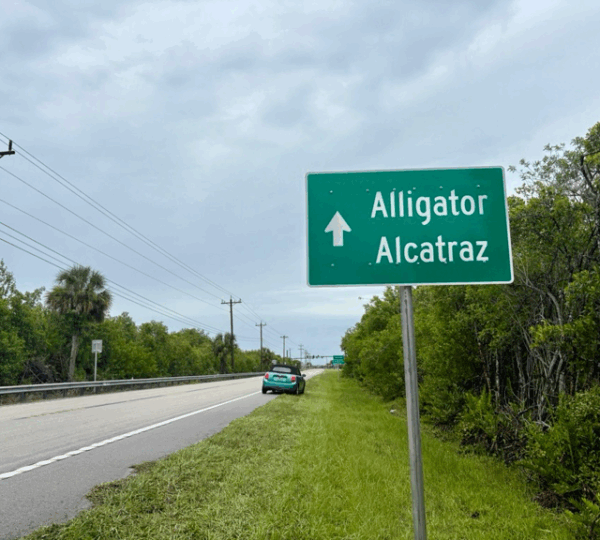
Alligator Alcatraz — officially known as the South Florida Detention Facility.
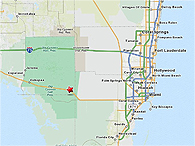
Is a newly established immigration detention center located at the former Dade-Collier Training and Transition Airport, deep in the Everglades near Ochopee, Florida.
The facility was announced in June 2025 by the state of Florida, under the initiative of the state attorney general and with support from the federal government (through the Department of Homeland Security, DHS).
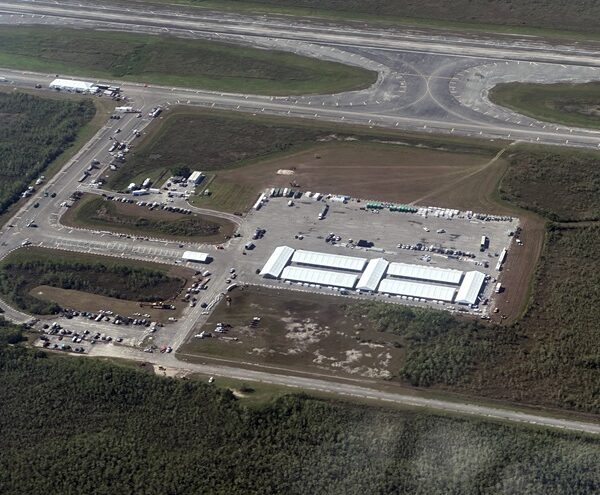
Within a matter of days, the abandoned airstrip was converted into a tent‑based detention center with the capacity to hold up to 5,000 detainees. Initial operations began in early July 2025.
Purpose and How It’s Supposed to Work
The center is designed to house, process, and deport criminal undocumented immigrants and others held under immigration enforcement programs, notably including individuals picked up under the 287(g) program which allows local law enforcement to detain unauthorized immigrants for potential deportation.

Florida officials describe the site as “secure and isolated,” citing its remote location, surrounding swampland, and local wildlife — including alligators and pythons — as natural deterrents against escape.
According to state statements, the facility includes more than 200 security cameras, over 28,000 feet of barbed wire, and roughly 400 security personnel, with plans to expand capacity in increments of 500 beds until the 5,000‑bed target is reached.
Political Context & Official Endorsement
The opening of Alligator Alcatraz coincided with a visit by Donald Trump on July 1, 2025 — just before the first detainees were scheduled to arrive.
During his tour, Trump praised the facility as a key element in his administration’s mass‑deportation efforts, expressing hopes to replicate similar centers in other states.
White House officials and Florida state leaders framed the center as a “cost‑efficient” solution to relieve crowded federal detention facilities and to enforce immigration laws more aggressively.
From a logistical standpoint, Alligator Alcatraz represents a dramatic shift: a state‑run but federally funded detention model, operating outside of traditional ICE detention centers.
Controversies: Human Rights, Environment, and Legal Challenges
Allegations of Abuse and Inhumane Conditions
Shortly after its opening, multiple human‑rights and civil‑liberties organizations raised serious alarms about the conditions inside Alligator Alcatraz.
According to a recent report by Amnesty International, detainees have described treatment that includes:
Confinement in small outdoor cages — the so-called “box” — for hours without water under extreme heat.
Overcrowding, unsanitary conditions (overflowing toilets, insect infestations), lack of adequate medical care, poor nutrition, inadequate access to legal counsel, and exposure to dangerous weather.
Reports of detainees verbally and physically abused by guards; solitary confinement for extended periods; some cases described as amounting to torture.
These allegations have prompted calls from human‑rights advocates and lawmakers for the immediate closure of the facility. Some describe the center as a modern-day internment site or concentration camp.
Environmental and Indigenous Rights Concerns
The site lies within the sensitive ecosystem of the Everglades / Big Cypress National Preserve, a region already subject to decades of ecological restoration efforts — efforts that state and federal governments have backed with billions of dollars.
Environmental groups have challenged the rapid construction and conversion of the airstrip into a detention facility, claiming no public environmental impact assessment was conducted.
The facility is also located on or near tribal lands, raising objections from Indigenous communities, including the Miccosukee Tribe of Indians, over land rights and protection of ancestral territories.
A federal judge briefly halted further construction on the site in August 2025 — blocking additional paving, lighting, or infrastructure work — though the facility was allowed to continue housing detainees pending legal challenges.
Legal and Political Response
A coalition of 67 members of Congress has questioned the facility’s legality and demanded oversight.
Civil‑liberties organizations, environmental groups, and Indigenous communities have launched lawsuits and appeals, challenging both the human‑rights conditions and the environmental legality of the center.
Meanwhile, state officials continue to defend the center as essential to enforcement of immigration laws, characterizing criticisms as politically motivated.
On the Ground: What We Know about Operations So Far
The first detainees reportedly arrived on the night of July 3, 2025.
The facility initially accommodated roughly 3,000 detainees, with plans for incremental expansion to reach around 5,000 beds.
Security measures include barbed wire fences, surveillance cameras, and a large staff, while the environment — remote swampland — is invoked as a natural barrier against escape.
Under the 287(g) program and other cooperation between state law enforcement and the federal government, detainees brought to Alligator Alcatraz include individuals arrested by local police for immigration-related offenses.
Why This Matters — And What’s at Stake
Immigration Policy & Enforcement
Alligator Alcatraz symbolizes a dramatic shift in how the U.S. — specifically Florida — is approaching immigration enforcement.
By building state‑run but federally funded detention centers with mass‑deportation capacity, the administration effectively expands the infrastructure for large‑scale removals.
If replicated elsewhere, as some officials have suggested, this could fundamentally change the landscape of immigration detention in the United States.
Human Rights, Legal Precedent & Moral Questions
The reported conditions — including overcrowding, lack of adequate medical care, and allegations of torture — raise serious human-rights concerns.
Courts, rights organizations, and lawmakers are now grappling with whether such a facility can exist under U.S. and international standards.
Furthermore, placing such a facility deep in a fragile ecosystem — and on lands claimed by Indigenous peoples — raises questions of environmental justice, historical preservation, and legal compliance.
Social Impact & National Debate
The facility has reignited fierce debate over immigration, enforcement, deportation, and the U.S. values of fairness and human dignity.
For many, Alligator Alcatraz represents a feared reality of modern immigration policy — mass detention in remote camps. For others, it is seen as a necessary tool to uphold immigration laws.
The actions of this one remote site could influence legislation, enforcement practices, court rulings, and public opinion nationwide.
What’s Next: Key Developments to Watch
Ongoing legal challenges — especially environmental lawsuits and human‑rights investigations — may result in permanent restrictions or closure orders.
Federal and state legislation related to immigration enforcement and detention may be reshaped depending on the success or failure of Alligator Alcatraz as a model.
Reports from detainees, NGOs, and monitoring groups will likely shape public perception and could pressure policymakers to reform or abolish such facilities.
Advocacy and humanitarian groups may increase efforts to protect detainees and promote alternative immigration solutions (e.g., community‑based processing, legal representation).
In Conclusion
Alligator Alcatraz stands as one of the most controversial and consequential developments in U.S. immigration policy in decades.
Born out of political ambition and constructed with surprising speed, the facility aims to house, process, and deport thousands of undocumented immigrants — particularly those convicted of crimes.
Yet from the beginning, it has been mired in controversy: accusations of human rights abuses, environmental damage, legal challenges, and moral outrage.
The name itself — evoking the notorious maximum‑security prison — signals the gravity with which its creators intend it.
Whether it becomes a model replicated across the country or ends in court‑ordered closure, Alligator Alcatraz has already transformed the debate around immigration, detention, and the values that define America.
Given the weight of the issues at stake — justice, human dignity, environmental protection, and the lives of thousands — the world will be watching closely as this story unfolds.
