Sudden Spotlight on a Brooklyn Artist
For illustrator and animator Rama Duwaji, public attention arrived abruptly. Accustomed to working quietly in her Brooklyn studio, she suddenly reached a far wider audience through a series of carefully styled images released in collaboration with The Cut. The response was immediate. Viewers focused on her distinctive visual presence and calm confidence.
Yet, rather than feeling celebratory, the moment felt vulnerable. Duwaji has long preferred to let her work speak for itself. Being widely seen before fully understood forced her to confront how quickly public narratives form—often simplifying complex creative identities.
Navigating New Visibility
Duwaji’s sudden visibility closely followed her husband, Zohran Mamdani, whose election as New York City’s mayor thrust her into a public role she had never sought. Online reactions poured in. Many praised her style and presence, while others framed her primarily through her new title.
Although she appreciated the kindness, Duwaji was candid about the discomfort of being defined mainly as a political spouse rather than an independent artist. Early media coverage focused on her relationship, often overshadowing her professional achievements. She reflected on how women in public life are frequently introduced through association before individuality.
Choosing Privacy and Authenticity
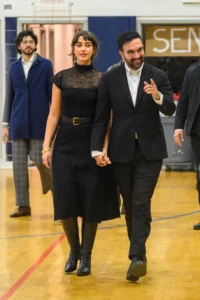
As attention grew, Duwaji and Mamdani made deliberate choices about what to share. They released a small selection of images from their courthouse wedding, emphasizing intimacy over spectacle.
Still, Duwaji acknowledged the pressure of sudden exposure. Large audiences can push creatives to overthink their work or soften their edges. To stay grounded, she focuses on her artistic peers instead of audience size. Humor and self-awareness, she says, help her navigate the tension between visibility and creative freedom.
Embracing a Nuanced Role
When discussing the informal title linked to her name, Duwaji approaches it thoughtfully. She understands that there are many ways to occupy a public-facing role, especially in a city as diverse as New York. While she is not a politician, she uses her visibility to support and highlight working artists who often struggle for recognition.
At the same time, she remains committed to her own work. She plans to continue creating illustrations, animations, and ceramic pieces that explore community and identity. As the city adjusts to a new administration, Duwaji stays focused: protecting her creative voice, setting healthy boundaries, and using visibility thoughtfully—rather than letting it define her.
