Trump’s $2,000 Tariff Dividend Proposal Sparks Debate
The conversation began on Nov. 9 after President Trump announced on Truth Social that most Americans — excluding high earners — would receive a $2,000 “dividend” funded by tariff revenue. He argued that strong markets, rising tariff income, and overall economic momentum made the plan possible.
Administration Signals Support — With Limits
A week later, on Nov. 16, Treasury Secretary Scott Bessent appeared on Fox News Sunday Morning Futures. He confirmed that the administration intends for the payments to reach working families. However, he stressed that Congress must authorize the spending before any checks, rebates, or tax credits can move forward.
“These payments could go out,” Bessent said, “but only with congressional authorization.”
He added that lawmakers would decide both the payout structure and eligibility rules.
A Costly and Complicated Proposal
This isn’t Trump’s first attempt to tie rebates to tariff revenue. Earlier this year, he said he was open to the idea but was prioritizing reducing the national debt. He later suggested additional savings might come from the Department of Government Efficiency (DOGE), which claims to have identified hundreds of billions in cuts.
However, new estimates from the nonpartisan Committee for a Responsible Federal Budget show a major challenge. A rebate modeled on COVID-era stimulus checks could cost up to $600 billion — far more than the roughly $100 billion in tariff revenue collected through October.
Supreme Court Review Adds Uncertainty
The Supreme Court is also weighing Trump’s tariff structure. Justices heard arguments on Nov. 5. If they strike it down, the government could owe billions in refunds to businesses and individuals. That ruling could directly affect the feasibility of any dividend program.
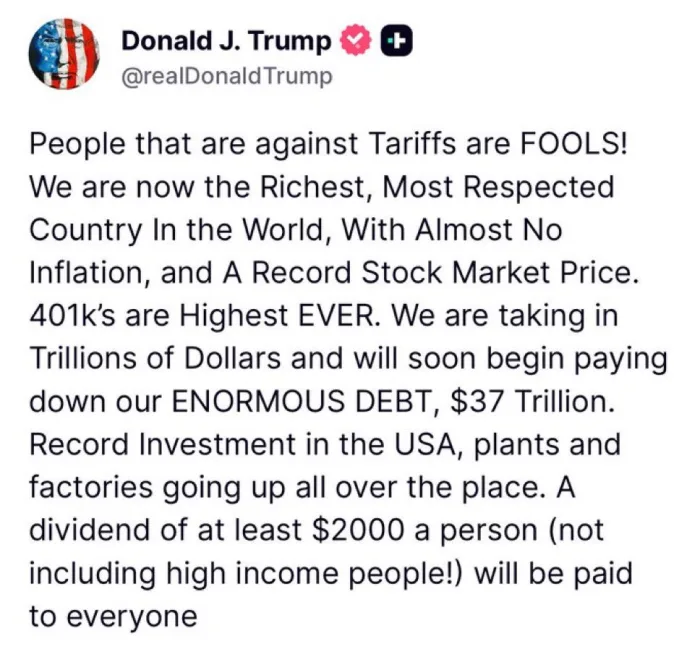
President Trump’s post on Truth Social about the $2000 tariff dividend, Photo Credit: Edamommy/X
Trump Continues to Promote the Plan
Despite the hurdles, Trump is promoting the proposal aggressively. In his Nov. 9 post, he highlighted soaring 401(k)s, low inflation, record markets, and “massive incoming revenue.” He insisted every non–high-income household would get “at least $2,000.”
During Oval Office remarks the next day, he said the plan aims to deliver roughly $2,000 to middle- and lower-income families while using remaining revenue to reduce the national debt.
White House Press Secretary Karoline Leavitt later said the administration is exploring “every legal option” to make the rebates happen.
How Payments Could Be Delivered
Bessent also hinted that the program may not start with physical checks. Instead, the first phase could appear as tax reductions — including no taxes on tips, overtime, or Social Security income, plus deductions for auto loans. Direct payments could come later.
He also previewed upcoming initiatives: larger tax refunds expected in early 2026 and a new $1,000 “birth investment account” for children born that year, with applications opening in July.
Eligibility Remains Undefined
Eligibility for the dividend is still unclear. Trump has not said what qualifies as “high income,” and no formal thresholds exist. Analysts using a CARES-Act model estimate that full benefits could go to individuals earning up to $75,000 and couples up to $150,000, similar to 2020 stimulus programs.
Congress Holds the Final Power
Ultimately, Congress must approve any rebate. No legislation backing Trump’s $2,000 tariff checks has been introduced. Sen. Josh Hawley did propose a smaller payment earlier this year — $600 per adult and child — but it never advanced.
The DOGE savings program also lags behind its $2 trillion target. As of Nov. 17, it reported about $214 billion saved — far short of what’s needed to fund large-scale rebates.
Bottom Line
Americans won’t receive tariff dividends until Congress acts, the Supreme Court rules, and the financing plan is finalized. For now, the administration insists the proposal is alive — but there is no timeline for when, or if, money will reach taxpayers.
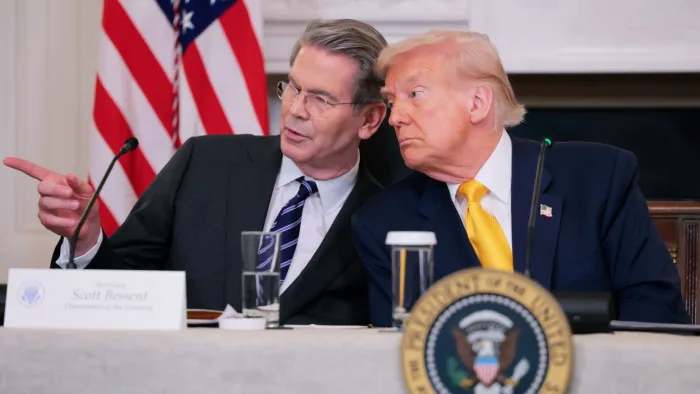
US President Donald Trump with Treasury Secretary Scott Bessent attending a meeting, Photo Credit: Armored Algo/X
