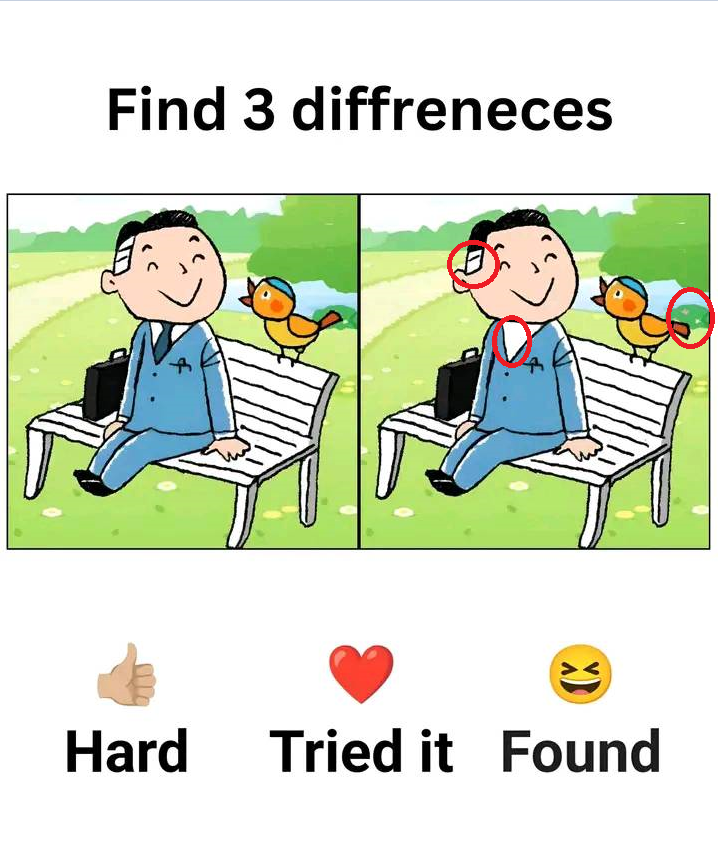
“Find the Difference” puzzles are more than just a casual way to pass the time—they’re a powerful tool to give your brain a real workout. These visual challenges are designed to boost your concentration, improve attention to detail, and help you train your eyes to catch even the smallest changes in everyday scenes. Today’s challenge involves two nearly identical images of a man sitting on a bench with a small orange bird by his side.

At first glance, both pictures seem exactly the same, but if you look closely, you’ll find that three subtle differences have been carefully hidden within the scene. The task is simple: can you spot all three differences before you read the answers? These types of puzzles are so addictive because they require you to slow down and truly focus. In an age where we’re constantly multitasking and speeding through content on screens, pausing to study every little detail in an image is refreshing—and surprisingly hard. Spot-the-difference puzzles tap into our visual memory and spatial awareness, forcing us to analyze and compare with a level of focus we rarely use in daily life.
And let’s be honest, few things feel as satisfying as catching a tiny detail that others miss. That moment of realization, that little “aha!” sparks a wave of dopamine in the brain, rewarding our patience and sharp eyes. But don’t be fooled into thinking these puzzles are easy. They’re crafted to trick your mind. One reason people often miss the differences is because our brains love symmetry and consistency. We naturally assume both images are the same, so we tend to overlook small changes. Another factor is how our eyes are drawn to big, bold elements like faces or bright colors, while the real differences often lie in the muted or background details.
And of course, many of us rush through these puzzles, expecting a quick win, when in reality, slowing down is the only path to success. Now let’s break down this specific puzzle and look at the three hidden differences. First, focus on the man’s suit jacket. In the left image, there’s a crisp white pocket square peeking out from his front pocket. In the right image, it’s completely gone. This change is incredibly subtle and can easily be missed if you’re not paying close attention to the clothing. But once you see it, it stands out clearly.
The second difference lies in the man’s tie. In the first image, the tie is long and narrow, hanging neatly down his shirt. In the second image, the tie appears shorter and wider—as if it’s been tucked or tied differently. The color hasn’t changed, which makes this alteration even harder to catch. It’s a clever use of shape and proportion to fool the eye while maintaining visual consistency. The third and final difference involves the bird. In the left image, the orange bird on the bench clearly shows two wings—one tucked close to its body and the other slightly lifted. But in the right image, the wing that faces the viewer is missing altogether. This one is especially tricky because our minds tend to “fill in” expected shapes, especially with familiar objects like animals. Unless you’re being very observant, you may not notice that anything is missing. To summarize, the three differences are: the pocket square on the man’s jacket is gone in the second image, the shape of his tie changes from long and narrow to short and wide, and one of the bird’s wings disappears. These puzzles don’t just entertain—they sharpen your brain. They improve short-term memory by forcing you to compare visual patterns and help you develop a keener sense of detail that can carry over into real-life problem-solving. If you got all three differences, great job! You’ve got a sharp eye. If you missed one or two, don’t worry—these puzzles are meant to be tough, and practice makes perfect.
Want to make it even more fun? Challenge your friends or family. See who can find the differences the fastest without zooming in. Ask which one stumped them the most. It’s a light-hearted, low-pressure way to bond and boost everyone’s brainpower. The more you do these, the more your observation skills improve—not just for puzzles, but for spotting subtle details in the world around you. Keep training your brain, and you’ll start noticing things others completely miss. Ready for the next challenge? Let’s keep those brain cells buzzing.
